Saturday, January 06, 2007

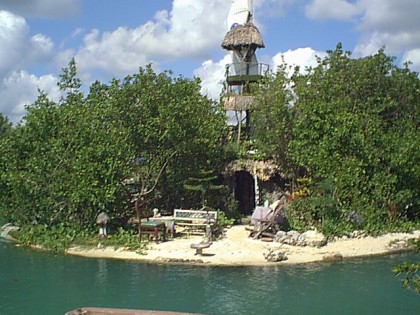
bottle island


as with many things and thoughts that are cool, i meant to have posted this a LONG time ago! sorry. http://www.geocities.com/spiral_island/

Thursday, January 04, 2007

global warming

eh hem... cough cough

"O yeah, this is a really warm winter. Global warming is great, right?"

Nobody's laughing, bitch. People have been knowing about global warming since the 1970's AD (and no, not CE, because it's still the same numbers based on the same mythical fucking date). And you're still not doing anything, except maybe talking about Al Gore's movie. Suck my dick.

Tuesday, January 02, 2007

Against His-story, Against Leviathan! Chapter 8 (the Phoenecian-like Greek polis)

Against His-story, Against Leviathan! Chapter 8

8.

Returning eastward from Thrace, the Persians tangle with Aegean and Anatolian Greeks, people called Mushki on ancient tablets. The Persians’ own one-time Scythian companions.

It is true that the Aegean and Ionian seas are veritable hornets’ nests of petty quarrels, feuds and never ending wars among puny cities.

But on closer inspection the former Mushki are not at all as the Assyrian and Babylonian tablets describe them. They speak the Greek dialect of the Persians’ own original tongue, but in all other respects those the Assyrians called Muski are Phoenicians-not like the Phoenicians of Darius’s day, but like the ancient world-embracing Phoenicians. They write their Greek with Phoenician characters, wear Phoenician garments, tell Phoenician tales, travel in Phoenician ships, and every little city has trading posts in every part of the Mediterranean, just like the Phoenicians.

Every city, called a Polis, has shrines to gods, some of them Phoenician. But the Temple is not where the gods are. The gods are in Agora, the marketplace.

The men of the polis are all merchants of wine and olives-all, that is, except the slaves-and all swindle and lie as expertly as Phoenicians. They claim to derive their physical strength from their vigorous exercising in the sun, but the Persians quickly learn that at least part of the Greeks’ strength comes from the shiploads of wheat which arrive daily, and although the Greeks try to lie about the source of the wheat, Darius discovers that these former Mushki have no trouble locating the Scythians; like true Phoenicians, they give a few jars of olives and some jugs of wine to a few Scythian strongmen and they return to the Aegean with all the wheat they can eat.

The Assyrian-armored Persians instinctively see the weak spot of these tiny Greek Phoenicias with their floating empires: the Greek cities cannot feed large armies; they must keep their wealth afloat and even to maintain it. The Persians know they can be masters of every Anatolian polis in a single campaign.

But such a campaign is unnecessary. The Greeks also know their own weakness, and each Ionian polis outdoes all the others in emptying all its visible coffers and ships to regale Darius the Great with more gifts than his army can carry to Persepolis. Like the second Hiram of Tyre, the Greeks try to buy their way out of the world-embracing Leviathan’s entrails.

The great Darius, cynically “King by the grace of Ahura Mazda,” surely recognizes something that makes these Greeks differ from all their predecessors.

The Greeks know that their gods are dead, that the Temples are empty. When they listen to a recitation of Hesiod’s description of the age when gods mingled with men, the listeners concentrate on counting the strophes in Hesiod’s lines.

Darius must wish the Persians who listen to recitations of Zarathustra’s visions would learn to concentrate on meter and verse. Darius’s own cynicism surely helps him recognize that the Greeks are becoming something we call Secular, and he surely thinks them unique in this, for he cannot know that distant Chinese are at that very moment hurling themselves into a similar secularism.

The Greeks still make, or pretend to make, sacrifices and offerings to their gods; they don’t kill and plunder for the sake of killing and plundering. But when they go to their Temples and shrines, the Greeks do not concentrate on gods, even dead gods. They concentrate on the lines, forms and colors of the roofs and columns.

How is this possible? The old Phoenicians couldn’t bear to live without their dead Baal, they couldn’t bear to see themselves as mere merchants of purple and ivory.

The Greeks can bear this no better than their mentors. They dread the thought of a new Hesiod describing a sixth generation made of no metal whatever but of wine and olive oil stored in clay vases. They speak of everything except the wine and olive oil and the slaves who harvest, squeeze and store the olive oil and the slaves who harvest, squeeze and store the juices. No, they do not think themselves merchants of wine and olives. They think themselves expert judges of lines, forms and colors, even those on the outside of the vases.

The Greeks are what we call Connoisseurs of Art. They’ve performed the feat of transferring the Temple’s activities to the Agora. They’re able to do this because few of their Temple’s activities came from their own past; many come from Phoenicia and never had much meaning for the Greeks.

When they’re through ransacking the Temple, they’ve forged activities that no longer have any connection to their own or anyone else’s past. What to all others is the sole reality loses all its reality among the Greeks. The great enactments are reduced to Drama, the shrines to architecture, the visions to Painting and Sculpture. The externalization of visions becomes Art; the internal probings become Philosophy; the sharing becomes Rhetoric.

The Greeks have inverted the relation between the Temple and the Leviathan. For all their predecessors, the artificial beast, however large and strong, was a mere tool, an instrument for feeding the dead gods in the Temple. But the Greeks have taken the fragments of their disemboweled Temple and turned them into mere ornaments of their Leviathan. The only god they worship is this polis, although they worship only a polis that is properly adorned.

Their Aristotle will think that their enactments and ornaments serve to purge people of their armor, to purify them, but this man will see many things through lenses that invert for him things clearly visible to others. The Greeks’ enactments and ornaments serve to prevent people from purging and purifying themselves, for they cover up the armor, mask it, give it the appearance of Art.

Darius the Persian must know that the Greeks are far ahead of his Canaanite subjects on the Levant who actually worship the abstraction of Leviathan, but who treat this abstraction as if it were a Sumerian god and make their actual Leviathan subservient to it. These Canaanites even persecute Ammonites, Moabites, Edomites, Samaritans, Phoenicians and other Canaanites who do not worship the abstraction in their Temple.

Only much later people who claim to be heirs of Moses will learn to worship the actual Leviathan, but in this they will be heirs of the Greeks and of the later English Greeks of Hobbes’s age who will try to perform the feat of worshipping Leviathan unadorned.

Darius and his strongmen learn what they can, and soon their capital Persepolis and their administrative center Susa fill with buildings which are not Temples and with monuments which are not shrines. Soon Architecture rises on the Fertile Crescent, for the first time, and Persians who had sought the light of Ahura Mazda find the artificial light of Art.

During the reigns of Zerzes and Artazerzes, the Persian Leviathan becomes increasingly adorned, and by the reign of the second Darius it is as pretty as a polis.

By the time the third and last Darius flees from Aristotle’s world-renowned pupil, the Persians will know of Zarathustra almost as little as the Greeks, and although the Greeks will render the name as Zoroaster, they will know only the name.

* * *

The Persian rulers try to stay out of the Aegean hornets’ nest, where every little polis would try to draw the entire worm into a petty feud against a neighboring polis.

Consequently, not every Greek polis falls into the Persian Leviathan’s embrace. And the unswallowed Greeks do not hesitate to exploit the handicap of their brethren, any more than Phoenicians hesitated to exploit the ignorance of their fellow-Canaanites whose Egyptian captivity had given them no understanding of trade.

Actually, not all Aegean Greeks benefit from the plight of their Anatolian brethren. Some, like the Spartans, are not able to derive any benefit from it. The Spartans, many generations earlier, had tried to remain in what Hesiod called their first age. Women had remained important among them, and men had been content to behave more as ornaments than as masters. But the Spartans had made the mistake of trying to preserve their vanishing community by forcing others to provision it, by conquering and enslaving their Messenian neighbors. Instead of preserving anything worth keeping, this act had turned the Spartans into frozen armors glued to their spears, ever-fearful that the former Messenians reduce to Helots would rise and extinguish the little that was left of Sparta.

The Greeks who gain from the Ionians’ discomfiture are the ones who have preserved nothing from their past, those of Corinth, Aegina, Eretria, and above all Athens.

Dracon’s laws have reduced seed planters to debtors, and former debtors are now slaves who ornament merchants of wine and olives. For the merchants, the world is an object of plunder. Earth is not Mother. She’s a swirl of moving atoms, just like the polis.

Every little city, although a hornet to Darius, is in fact the head of an octopus, with free-moving tentacles probing every cove and crevice along the Mediterranean’s shores, with trading posts and colonies on the shores of Africa, Spain and Italy. The Greek tentacles try not to cross paths with the tentacles sent out be Carthage, Gades or Tartessus, for the Greeks are not sure of their commercial prowess in the face of the actual Phoenicians who still operate from these places. But the Greeks, especially the Athenians, go everwhere else, and nothing deters them from sending ships full of merchandise to the outposts and colonies of the unfortunate Ionians who have to empty their ships to please Persian Darius. And by defeating the fleet sent against them by Darius’s son Xerxes, the Athenians save themselves from paying tribute to Persia and quickly become as wealthy as their Phoenician mentors’ surviving heirs, the Carthagenians.

* * *

Now begins the rise of that great and greater Athens so highly admired by the later Western Spirit and its so-called Renaissance. The following six generations will teem, in armored Western eyes, with infinitely varied “forms of freedom.”

The “forms of freedom” will be visible to those who look at Athenian Rhetoric and not at the slaves, grapes and olives.

Athenian rhetoric proclaims that the Anatolian cities are now free and can resume where they left off.

But the undefeated Athenian navy embraces them all in a Delian Confederacy, a rhetorical name for the Athenian Empire. Caian and Lydian towns which politely refuse to be embraced are coerced by the seaborne Athenian octopus that replaces the landborne Persian worm.

Discord reaches the metropolis itself. Two parties form, a Worm Party and an Octopus Party.

The authoritarians in the Worm party know that an empire needs a large concentration of military power to keep from dismembering.

The merchants in the Octopus Party, led by the constitutional tyrant Pericles, know that the wealth of Athens comes from its freely-moving tentacles, and that a large military concentration would eat up the sources of the wealth, empty the ships and lose the empire. The merchants know that the tentacles are not free human beings but bits of armor, parts of the polis, splinters which, like arrows, serve their purpose only when they’re loosed.

For this mercantile good sense, Archon Pericles will be praised in a later day as a defender of freedom.

Pericles defends the freedom of commodity circulation, not the freedom of people. Two thirds of the population of the very metropolis consists of zeks, of labor gangs engaged in mining, quarrying, crafts, personal service. And the cities in the Athenian Empire are tribute-payers like the cities in the Persian Empire.

The Worm Party is defeated, but Athenians do not give up their wormlike aspirations. They try to embrace their entire hinterland, Hesiod’s Boeotia, within their Empire. This leads to war with Thebes as well as Sparta, and the Athenians under Pericles begin the metamorphoses, the almost daily change from a flexible octopus to an entrenched worm, to and fro. Under Pericles they send tentacles to Egypt, yet build walls. Defeated by Spartans and their allies, the Athenians give up their land empire, but they rush to reduce sea colonies Samos and Byzantium.

Inside the metropolis itself rise what Toynbee will describe as supremely beautiful architectural works paid with imperial tribute exacted by Athenian armed force and, I would add, by commercial wile.

Periclean freedom is the freedom of claws and tentacles to grab whatever can be reached. It is the function of the supremely beautiful art and architecture and drama to conceal the claws and tentacles, first of all from the Athenians themselves.

The Athenians are nevertheless aware of the claws and tentacles, since they operate them. Only later apologists for other claws will see nothing but supreme beauty in Periclean Athens.

Flushed with the power of successful imperialists, Archon Pericles and his fellow merchants go too far. The Athenians themselves call such overreach Hubris: blind arrogance. They try to grab for themselves the overseas outposts of Corinth.

But Corinth is not an Ionian polis disabled by Persian tribute collectors. Corinth is a next-door neighbor, second only to Athens in overseas possessions.

Now begins the tale of inhuman violence by land and by sea, of enslavements, massacres and plagues known as the Peloponesian War and preserved for etenity’s perusal by Thucydides.

Every Athenian ally, every confederate and every colony rebels against the form of freedom Periclean Athens had shared with them.

After more than a generation of fratricidal and genocidal war, Athens is reduced to just another polis, a polis overloaded with monuments of past glory.

And the reduced Athenians become pious. They order the execution of a man called Socrates because he announces publicly that the Athenians’ gods are dead. They’ve been dead for ages, but this is not the time to announce their demise. Without the cover of their gods, Athenians are only wine and olive merchants, and not first rate merchants at that. The Phoenecians of Carthage on Africa’s northern shore are shrewder, and among Greeks, Syracuse has outrun Athens in size and wealth, if not in beautiful works.

The great age of Athens is over. Athens has risen and fallen. All that’s left is Plato’s attempt to found the ideal Leviathan, the perfect polis.

Plato is a typical Athenian. He speaks of the Leviathan with the language of the Temple. He concentrates on the ornaments that conceal the armor. He refers to slaves, grapes and olives only when he explains that some are born to squeeze the juices, others to sell them. Actually, he thinks slaves will be happy if someone explains this to them.

Plato does not know, cannot know, that a contemporary of his in distant China is devising an almost identical theory using the language of Leviathan itself, unadorned.

This exact contemporary of Plato is Shang Yang, minister to the Duke of Ch’in who is their heir to a worm segment on China’s western edge, a segment that may have been carried there by Assyrian-influenced pastoral nomads or even by Scythians.

Shang Yang’s ideal polis has none of Plato’s frills. The philosopher-king of this Republic starts things moving by making the land of peasant communities a marketable commodity. Next, merchants impoverish the peasants and drive them into debt. Now the Duke expropriates the defaulting peasants, or else the peasants themselves sell their land to get out of debt. Either way, the ancient community based on kinship is broken up, the land passes to the Duke and his henchmen, and a large number of landless former peasants is available for labor gangs and armies. On this solid basis, Leviathan is constructed. It is bonded by coercion. Its elders are the secret police. Its argument is terror. Music, poetry and morality subvert its ends and are totally liquidated. The purpose of the machine is to enlarge itself by perpetual war and preparation for war.

* * *

Plato and Shang Yang both find monarchs to whom to offer their services, but only Shang Yang’s accepts the offering. The Syracusan tyrant to whom Plato offers his services has no use for the frills. Syracuse no longer uses the language of the Temple.

Plato’s admirer and pupil Aristotle puts the master’s wisdom into textbooks, a form suitable for the Academy, and when Philip the Macedonian invites this philosopher to tell his son Alexander all there is to know about the polis, Aristotle accepts the invitation.

Philip himself has been getting along without the philosopher’s wisdom. He started out
by repairing a rusty segment abandoned in Thrace by Darius the Persian during the hunt
for Scythians. Philip knows things that Aristotle doesn’t know. He knows—perhaps
intuitively, perhaps he’s heard of Phoenicia’s fate—that a seaborne octopus is no match
for a landborne worm, especially now, when every polis in the Aegean has been
exhausted by Athens’s attempt to be both an octopus and a worm.

The last defender of the Athenian octopus is a man called Demosthenes. Others send embassies to Phillip. The Octopus Party founded by Pericles seems to have perished with the sea empire.

Demosthenes defends the octopus. But Demosthenes is an Athenian and an orator. He speaks Rhetoric, the ornamented language that conceals instead of revealing. If he wer Shang Yang he would speak directly of the wine and olives, he would remind his fellow Athenians that their wealth, such as it is, still comes from the continual circulation of the commodities in their ships, and that even a brief visit by Philip’s army would empty the ships; should Philip stay longer, the ships would stop moving and the Athenian merchants would become as poor as their slaves.

Demosthenes’ listeners would be deaf even to Shang Yang’s clear warnings, because the Athenians prefer to face several Philips rather than another Peloponesian war, and other Greeks cannot imagine the Macedonians being worse than the Athenian Confederation. They invite, or at least pretend to invite the Macedonian, silencing all who call for resistance.

And of course they’re wrong and Demosthenes, or rather Shang Yang, is right. Athens fares no better in the entrails of a Macedonian worm than the second Hiram’s Tyre fared in the Assyrian worm.

The story of the Greek polis and its free-moving tentacles is completely over. Leviathanized humanity has taken another great step up the ladder. Philip of Macedon will be a name known to every schoolchild.

The only polis left is distant Syracuse, situated on an island halfway between Italy and Carthage, and Syracuse will never be as pretty as Athens still is. The Athenians had ransacked their Temple and pulled its contents into the Agora, they had already profaned what was once sacred, but they had done all this with painters’ brushes, with Art. The Syracusans do it with butchers’ knives, and soon their Archimedes will sell the power of the visionary to a tyrant who will turn them against Life itself, against Mother Earth. This Archimedes will boast “Give me a place to stand and I’ll move the world,” and when the tyrant kills with the inventor’s levers and pulleys, Archimedes will shout “Eureka!” Syracuse is no longer a pretty polis. It is situated between the ornamented world of the Greek polis and an unadorned future world of labor gangs and killing machines whoe dried up visionaries will express their lethal moral precepts by translating “Eureka!” into “It works!”

As soon as Philip enters, Achaean Greeks leave their beautifully ornamented cities. Their ships start to rot and will soon join the ships of Tyre on the bottom of the sea. The former wine and olive merchants hire themselves out to any ruler with wealth enough to engage mercenaries. From now on there will be Greeks on both sides of every war in eastern Eurasia west of China.

Philip is apparently murdered by order of young Alexander’s mother. The brave Demosthenes proposes a decree to the memory of the tyrant’s murderer.

But the tyrant’s son is not about to put into practice precepts he learned from Aristotle. Neither his mother nor his father’s strongmen have this in mind. Even if Alexander looked behind his teacher and learned on his own about the grapes and olives, there’s nothing he can do to make the octopus run.

So twenty-year old Alexander lets himself become “the Great.” He lets a handful of strongmen call him General of the Greeks, and he sets out with his flatterers to become King of Kings and Lord of Lords, following paths broken in for him by Crus, two Sargons and Lugalzaggizi, at last burning out in Babylon at thirty-three.

Many of the remaining Greeks leave the polis to help raise the General of the Greeks to the throne vacated by the third and last Darius, and they encounter fellow Greeks hired to keep the Persian from falling off his throne.

These Greeks, at least some of them, become administrators of the realms carved out of Alexander’s unwieldy Leviathan by the strongmen who’d had precisely this in mind when they’d set out with Aristotle’s pupil. Each strongman becomes a King of Kings in one or several of the myriad languages of Alexander’s decomposed Leviathan, and soon Greek ornaments, the frills that will later be hailed as “forms of freedom,” adorn, cover and conceal the fangs and claws of every conceivable type of artificial worm.

* * *

After the greatest of all Greek victories, the Greeks who welcomed Philip are shackled by tribute collections, conscript hunts and night searches—what we will call taxes, law and order. The very homeland of the polis is invaded, occupied, garrisoned, and plundered, first by Philip’s former strongman Antipater, then by Alexander’s mother, later by a sequence of Antigonuses, Demetriuses and Philips, until a fifth Philip experiences the fate of the third Darius and falls into the jaws of the next Leviathan. Another His-story ends. Enthusiasts for the polis become librarians and antiquarians.

This sequence of atrocities will turn up in books of His-story as an edifying sequence of advances. But these events are not experienced as human advances by those who live them.

The playwright Menander expresses the depth of his enthusiasm for the march of Civilization by reflecting, “Wisest is he who has fewest expectation, and happiest who dies young.”

The philosopher Zeno no longer has even a shred of the patriotism of his predecessor Aristotle and Plato. In Zeno’s eyes, everything in the Leviathanic world is a necessary evil. The enthusiasm of the polis-builders gives way to the resignation of zeks.

Epicurus says it too: Hell is right here, it is the man-made world you’re in, and the gods are too remote to help you, so live unobtrusively and, with luck, you’ll have nothing to fear.

There are some, called Cynics, who go even further. They say there’s nothing at all human about Leviathan, and the only human alternative is to disregard Polity altogether and live by one’s conscience.

Not since Hesiod’s age have Greeks turned their backs on Civilization so completely.

The resistance, rejection and withdrawal are either skipped in accounts of His-story, or else they’re compartmentalized and explained away as “religion.” Yet these are the only parts of the story tat have any human meaning. All the rest is a tale of worms, a tale of huge, maneating, earthwrecking artificial worms.

The story of Alexander’s successors is a tale of cruelty and war between rival Leviathans trying to eat each other. They all end up being eaten by a worm manned by new pastoral nomads fed up with conscript hunts, tribute raids and merchant caravans. Nomadic Parni tribes through whose lands the caravans move to China and back set out to shorten Civilization’s career, but like so many predecessors they end up stretching a Parthian Leviathan over the eastern provinces of Alexander’s realm.

Next door to Parthia, Cheng puts Shang Yang’s precepts into practice and becomes Shih Huang-ti, first emperor of a unified Chinese Leviathan.

In the Mediterranean, everyone’s eyes are on Syracuse, the last surviving wealthy and powerful Greek polis. Syracuse is starting to tangle with the Carthaginian octopus. But we will look elsewhere, because we will know that both Syracuse and Carthage are going to be swallowed—Carthage will in fact be destroyed—by a worm no one can see yet, a worm called Rome.

* * *
Monday, January 01, 2007

unleash your inner beer ape!

in all the partying that i've done recently, it's something i've more deeply contemplated. i've cracked the Tao te ching to help me, and an unexpected entity has helped put the Taoist lessons into my context. you can meet him at the following link:

http://youtube.com/watch?v=nx2qiKotNy0

his name is the Rolling Rock Beer Ape. in the video i linked to above, he is shown parachuting into a beerless, zestless group of people who lounge by a pool.

here's a quote from the beginning of the Tao te ching:

So it is that existence and non-existence give birth the one to
(the idea of) the other; that difficulty and ease produce the one (the
idea of) the other; that length and shortness fashion out the one the
figure of the other; that (the ideas of) height and lowness arise from
the contrast of the one with the other; that the musical notes and
tones become harmonious through the relation of one with another; and
that being before and behind give the idea of one following another.

as the as the Double R. B. Ape parachutes in, the assemblage becomes excited- he represents renewed prospects for their gathering. "Look everyone, it's the Rolling Rock Beer Ape, and he's here to save the day!" what about this fantastic animal differentiates him as a savior?

it's not any physical attraction they feel to him. something is good about this being, though he doesn't have the distinguishing slimness, youngness, pale skin, or near-hairlessness characteristic of the crowd. the standards of beauty that the scantilly clad men and women in the commercial could use are not even applied, and so are they able to pleasurably appreciate him.

the ape signals his willingness to party by removing his shorts to reveal a man thong. a girl's eyes bulge. do not mistake her reaction as necessarily a sign of sexual attraction. the ape dances with the bikini clad lads and lasses, but there's no grinding or focus on the pubic areas of anyone beyond that girls initial eye bulge. what could it mean? my interpretation is this: the ape is consciously crossing a very dangerous border between sentient species. he' building new bridges between people (and presumably, apes) from different backgrounds. has Jane Goodall even done as much as might be happening in this add? also, as Darren Nash could tell you, gorillas have much smaller members than the average human party goers do. in this context, we can safely say that the girl's bulging eyes are an elated reaction to this monumentous occasion. i admire his escapades, and apparently she does too. his behavior could save the world.

because he appears in a rolling rock brand beer commercial, the crowd's reaction to the Ape are staged and designed to focus our desire on their beverage. but is it his gift that makes the monkey special to the partygoers? i'd say no. besides the ape deftly tossing and distributing the beer, there's no focus on it. nobody is seen putting it to their lips. they're all seen instantly dancing and enjoying themselves himself WITHOUT ever imbibing. you can't even tell if the beers that some peope are seen holding are open. it's the powers of their minds that's changed their level of happiness for the good. MIND OVER MATTER. you are open to having a good time, you see no reason not to have a good time, and then you have a good time- that's how it happens.

it doesn't appear that the ape desires any THING, and he ends up being fulfilled simply with human company. it's never clear what he comes for, where he came from, and where he goes (besides into the pool while playing electric guitar). by loving their experience with the Double R. B. Ape, people are showing appreciation for the Taoist non-expectation/non-judgemental frame of mind leading to fulfillment. they're also cooperating with a powerful, intelligent, non-human life form for mutual benefit. just to tack an additonal thought to the end of this rant, they're also showing a sort of tribal, nature sited enjoyment- people, shed of inhibitions, outdoors, sunshine, clean water, living grass to dance on. i don't typically encounter this scenario in apartment parties, dorm parties, office parties, and other parties that are removed from the natural elements, unless I recreate the natural elements in my own head and heart. there's a lot of good stuff here.

I want to wish you happy new year and advise you to UNLEASH YOUR INNER BEER APE. good night

elder

i went to a notable party, few days ago. it was the 90th birthday celebration of Gordon L. Maham, a contemporary of locally famous anti-war, anti-gentrification activist Maurice McCrackin. people HATE McCrackin, cuz he bought up a bunch of blighted real estate and made it legally difficult for gentrification developers to use.

anyway, Gordon is so cool. he has this big organic farm and a bunch of pet buzzards, which he collects road kill for everywhere he goes. "I take plastic trash bags with me, and when I see something dead on the side of the road". At 90, I was impressed by his ideas and energy, even if some of his sentences weren't finished or didn't technically conjunct together very well. I told him that I was planning to do a permaculture internship, which was like sustainable organic gardening. "Well, my farm is about as sustainable as it can be. You know what ISN'T sustainable? Guns. I don't think guns are sustainable. Which means the war in Iraq isn't sustainable." Then he gave me a final smile and walked away. If happiness and idealism are the last mental functions left to me when I'm 90... what more could one hope for?!

Tuesday, December 26, 2006

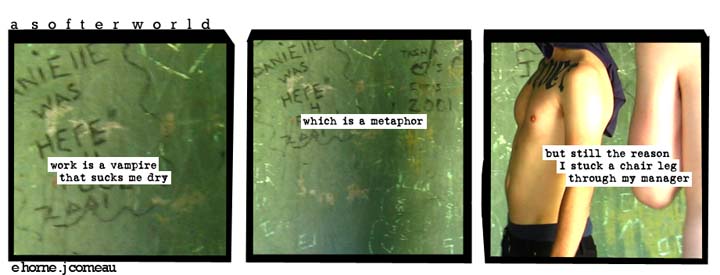
these webcomics make me happy


check 'em out

http://www.asofterworld.com/

some essays

i wish i weren't so scatter brained, so i could get through long essays with ease. i don't, but here are some potentially good ones that you might read. the first two are links (and one's fucking 14,500 words long!), the third one's cut and pasted.

http://libcom.org/library/soul-of-man-under-socialism-oscar-wilde

http://www.hccentral.com/eller12/index.html

PARADISE GARDENING by Joe Hollis

We want to save the world, and we want to save ourselves. It's the same thing. The problems confronting us are enormous and at every level: personal, social, planetary. I will spare you a list. My aim is to suggest that they are all symptoms of one problem, and to propose a solution.

The problem: to find a way to live on earth which promotes our health and happiness / is conducive to the full development of our innate potential, and at the same time, is "democratic", that is, available to all / not using more than our share, and harmonious with the biosphere's evident drive toward increasing diversity, complexity, stability.

Our world is being destroyed, in the final analysis, by an extremely misguided notion of what constitutes a successful human life. Materialism is running rampant and WILL COMSUME EVERYTHING, because its hunger will never be sated by its comsumption. Human life has become a cancer on the planet, gobbling up all the flows of matter and energy, poisoning with our waste. What can stop this monster?

Nothing. Just this: walk away from it. It is time, indeed time is running out, to abandon the entire edifice of civilization / the State / the Economy and walk (don't run!) to a better place: home, to Paradise.

Paradise is, first of all, a garden. A garden in which everything we need is there for the taking.

2) And Paradise Gardening is a way of life which serves to maintain the garden, and is in turn maintained by it. Odum calls this the "ecosystem manager... an organism that utilizes a small fraction of the total energy budget and in return provides a service which aids the system in its function and continued survival." ( The concept "illustrates the ideal which man should imitate in his attempts to manage a natural ecosystem.") Genesis, with the characteristic compression of myth, says we were put into the garden " to dress it and keep it." Same thing.

3) Paradise gardening is not work. Work is a subjective concept: one person's play may be another person's work. It has nothing to do with effort: tennis, for example, is usually "play" ( unless you're a pro), sitting at a computer terminal is frequently "work". Work is whatever you are doing when you'd rather be doing something else. Paradise Gardening is not "work" in the same sense that what a bear does all day is not "work". This is the distinction which the Taoists make between "doing" and "not-doing". Genesis refers to the same matter in saying that only outside the garden do we have to earn our living " by the sweat of our brow".

4) Paradise Gardening is not agriculture. From chemical to organic agriculture is a step in the right direction, but only the first step. Agriculture itself is, after all, half of the one-two punch that knocked us out of Paradise in the fist place. (Good) farmers, to be sure, love nature: but they love her in the context of plowing her up every year and deciding what to grow next. Our addiction to annual species and disturbed habitats has put us at odds with the main thrust of the biosphere ( and ourselves).

Oh, Earth is patient and Earth is old
And a mother of Gods, but he breaks her,
To-ing, fro-ing, with the plow teams going,
Tearing the soil of her, year by year.
Sophocles, Antigone

Every spring, nature begins again to clothe the earth in beauty, the process of succession, the initial strands of the intricate web, rebirth of the Tree of Life. An every Autumn we scrape it off, rake it into barns, take it to market: we increase human diversity and complexity (butcher, baker, candlestick-maker...) by appropriating to ourselves processes which are meant to benefit all.

Paradise is a habitat and a niche. Eliade refers to a universal "nostalgia for Paradise". Memories coded into our genes of our place, our fit. How, after all, does a bird (for example) select a place to build a nest? So many factors to consider (and such a small brain!). It just picks the most beautiful spot available. It was born with a "template" for Paradise. Concerning this the Book of Odes says "The twittering yellow bird, the bright silky warbler, comes to its rest in the hollow corner of the hill", and Confucius commented "Come to rest, alights, knows what its rest is, what its ease is. Is man, for all his wit, less wise than this bird of yellow plumage that he should not know his resting place or fix the point of his aim?"
(Pound, trans.)

Like any other creature, we are our niche. By our physiology and behavioral programming we are born to live a certain kind of life. Paradise is our birthright and our duty.

Now, instead, we take up a niche in civilization. The premise of civilization is that if everyone is a less than complete human being (I'll be the brains, you be the back), it will be the better for us all. This insulting premise has guided us for so long that we are unaware of an alternative. We equate "making a living" with "making money". Thus we spend the best hours of our lives pursuing our careers, being part of the cancer.

But everything needful to be completely human is available to us in the environment - the garden and the neighborhood. We can rely on the truth of this because "human-ness" is a creation of the environment, the most recent manifestation of a coevolution between our genes and all the other genes out there that has been going on since the beginning of life on earth. Much chancier is the possibility that everything we need to be completely human is available to us in the city, or through money.

The last time we lived in paradise it was as "foragers": hunters and gatherers, omnivorous, opportunistic exploiters of a variety of environments. Specialists, not of disturbance but of diversity.

This lifestyle has gotten a lot of attention recently ( at the very time that the last vestiges of it are being eradicated). The view that foraging is a superior (to agriculture) adaptation is now well established in academia and the same theme appears in popular literature (E.g. Bruce Chatwin, The Songlines and Varges Llosa, The Storyteller, both inspiring).

A revolution in the study if human niche was prompted by the realization that foragers, far from living on the brink of starvation, as previously imagined, actually had more leisure than anyone else (Lee & deVore, Man the Hunter). Boserup (The Conditions of Agricultural Growth) suggests that there have never been any "agricultural revolutions", in the sense of a sudden invention of a great new way to produce food; but rather that increases in food production always come at the cost of even greater increases in labor (or fossil fuel) input, that the techniques were always well known to the producers, but resisted until finally demanded by the rising population ( or the demands of the upper classes for a surplus, a "cash crop"). "Agriculture permits denser food growth supporting denser population and larger social units but at the cost of reduced dietary quality [less diversity to choose from], reduced reliability of harvest [eggs in less baskets], and equal or probably greater labor per unit of food...agriculture is not a difficult concept but one readily available to hunting and gathering groups..." (Mark Cohen, The Food Crisis in Prehistory)

Agriculture, in turn, allowed population to expand more rapidly. Any attempt to live a foraging life in the modern world would seem to be only an interesting but ultimately irrelevant exercise of the "historic village" variety. That "there is no going back" is merely a truism. What those who recite it mean to say is that there is no changing direction, progress can be only a straight line - from an original home in nature to a world eventually completely human, domesticated, farmed.

At this point, I would rephrase the "problem" with which this essay began: How can we, with our contemporary tastes and population level, live and coexist as foragers (ecosystem managers)? "Caught in the devil's bargain", how can we "get ourselves back to the garden"? (J. Mitchell, "Woodstock")

The strategy here proposed, Paradise Gardening, may be described as "intensified foraging". David Harris, in a series of papers, explored "alternative pathways to agriculture". Particularly valuable is his distinction between "agricultural manipulation and transformation...agricultural utilization may - and, if sufficiently intensive, usually does - lead to the transformation of a natural into a largely artificial ecosystem: the replacement of a tropical rainforest by plantation, of temperate woodland by wheat fields...But agriculture may proceed by a process of manipulation which involves the alteration of selected components of the natural system rather than its wholesale replacement- a method of cultivation which involves substituting certain preferred domesticated species for wild species in equivalent ecological niches and so simulates the structure and functional dynamics of the natural ecosystem". Harris has recently edited a collection of papers (From Foraging to Farming) which which further explores the emerging realization "that many 'non-agricultural' peoples were in fact engaged in intensive and sophisticated plant practices which did not fit our idea of agriculture".

Our goal is to "naturalize" ourselves in the environment. This will involve changing ourselves and changing the environment: convergence toward "fit". Perfect fit means the free and easy flowing of matter and energy between ourselves and our environment; life lived as a complete gift - from the garden to us, from us to the garden.

But that is in the future, what we need now is a process, leading to that goal, which is justified on its own terms. Focus on the ideal Paradise Garden will tempt us to take shortcuts, perpetuating the same old pattern of selling out the present for some imagined "better" future. "No act is good unless its goodness is seen in the immediacy of the act. An act which justifies itself by appealing to a greater good... all appeals to reason, expediency, and necessity, are appeals to the very force that wreck all ideals. One must have courage and be willing to take risks". (Wm. Thompson, Evil and World Order)

Ecology teaches that a "pioneer" (disturbed) environment favors life forms that are fast growing but short- lived, wide-spreading, "greedy"- designed to capture the maximum of sunlight and unoccupied soil. But eventually they are succeeded by the trees, which, because they invest energy in making wood, grow more slowly at first, but are more stable, longer-lived, and finally faster growing, more influential, the "dominant species", towering above.

We have spread ourselves over the earth, and used or burned just about everything that's easy to get. The age of the greedy ones draws to a close ( they don't know it yet). At last, we may hope, the "competitive advantage" passes to the practitioners of permanence, rooted-ness, slow growth and steady accumulation, the vertical expansion of the human spirit into realms uncharted, or long forgotten. A tree derives its satisfaction from the view achieved.

The process of Paradise Gardening involves:

-Extricating our life-support system from civilization/the Economy (bluntly, money), and reattaching it to the natural world of garden and neighborhood. This will be a gradual process requiring a real analysis of our needs and expenditures. Thus, for example, cars and gasoline are not needs but only the means to the satisfaction of needs. The solution is not gasohol but reducing the reason for traveling (usually the getting and spending of money). Concerning this the Tao Te Ching says "The country over the border might be so near that one could hear the cocks crowing and the dogs barking in it, but the people would grow old and die without ever once troubling to go there". (Ch. 80. See Needham, Science and Civilization in China, vol. II for a discussion of " the political program of the Taoists: the return to cooperative primitivity.")

The key to the self justifying nature of the process is this: things made or done by professionals or machines may be technically superior to one's own efforts, but are generally lacking in a quality which following Castenada, I will call "heart". Satisfaction from things bought usually peaks at the moment of purchase and declines rapidly. Needs which are met by the interaction of ourselves and nature are more deeply met, and there are wonderful surprises along the way. The truth of this will be evident to anyone who has ever made anything "from scratch". What seldom occurs to us (Someone doesn't want it to occur to us) is that an entire life can be constructed on this basis.

-The (re)integration of needs: not to the market for food, the spa for exercise, the doctor for healing, theatre for entertainment, school for learning, studio to create, church for inspiration, etc., but to the garden for all these at the same time.

-Enriching the garden by naturalizing useful and beautiful species and learning to incorporate them into our lives. We begin , of course, with the present and potential natural vegetation, to which may be added species introductions from similar areas worldwide; then slight modifications of the environment - micro-habitat enhancement - and the resultant possibilities for new species: a palette of plants, a Cornucopia* never available to previous generations.

A well-known biologist proposes "Planned biotic enrichment: It is within the power of science [you and me] not merely to hold down the rate of species extinction, but to reverse it. Among the principal topics of community ecology now under intensive study is the species packing problem...Theoretically, assertive equilibria can be planned that exceed any occurring in nature. Species might be drawn from different parts of the world..." (Edw. Wilson, "Applied Biogeography"). Wilson goes on to discuss " the creation of new (biotic) communities" and "ecosystem manipulation: the ultimate game... the very size of the world biota is itself a challenge that only generations more of study will encompass. The possibilities for ecosystem manipulation...offer creative work that is orders of magnitude even more extensive..."

-Hand labor. We all have two hands, one lifetime, twenty-four hours in every day. These are "democratic" factors. Working by hand on a small piece of land we can create a Paradise with relevance for all. Money, machines can't get us there any faster, in fact can't get us there at all, lead us astray.

We live during a narrow "window of opportunity". Having come, at last, to the realization that a revolutionary shift of consciousness and lifestyle is required, we find that we have only a few generations to do it in, before it will be too late to make a transition (environment degraded, resources depleted, species extinct, soils eroded/ polluted, population doubled...).

Our enemy is a paper tiger because it can't deliver the goods. The world waits for examples; to be shown, not told, a better way. Paradise Gardening is vastly more meaningful than the "biodome" experiment, and anyone can play.

We have been putting this off for too many lifetimes now.

You see the beauty of my proposal is
It needn't wait on general revolution
I bid you to a one-man revolution
The only revolution that is coming
(R. Frost, "Build Soil")

*Cornucopia, S.Facciola. Kampong Pub., 1870 Sunrise Dr., Vista CA 92084. Astounding new publication. Three thousand edible species, many more thousands of cultivars, sources of supply and information for each entry.

***************************************************

This article was written about 20 years ago (which will account for a few dated references) - the result of several winter's reading with the goal of developing a philosophy to underpin the garden-making project which I had already begun. I don't have the heart to rewrite it, but in the interim have learned a few other things which bolster the argument, so I add them here:

What drives (over)consumption?
Civilization (in the original - latin - sense, from civitas, the state), mimics the natural ecosystem. Consider the 'trophic pyramid' - a large biomass of primary producers, above which a smaller mass of primary consumers, above that a still smaller mass of secondary consumers, etc. A lot of plants support a smaller number of cows, which support an even smaller number of lions...The civilized version of this has peasants and laborers on the bottom, above them succesively smaller layers of administrators and merchants, political leaders and capitalists

Consumption (other than a minor component of 'basic human needs' - whatever that may be) is about defining one's place (status) in the hierarchy of civilization. Consumption is communication. I am indebted for this insight originally to Mary Douglas The World of Goods, but by now it's pretty common knowledge - certainly to marketers. And, of course, the old saying 'keeping up with the Joneses' concisely expresses the same idea. Still, it's useful to look at it baldly: consumption is communication, it's about saying who we are, our status, our affiliations. But surely there is a way to communicate that doesn't involve burning down the house?

"Civilization originates in conquest abroad and repression at home. Each is an aspect of the other...politically 'weaker' peoples were confronted with a single set of alternatives...This historical fact [conquest] is then reflected as a law of development; as civilization accelerates, its proponents project their historical present as the progressive destiny of the entire human race...
No matter how far we range in time and space, from Teotihuacan to Angkor Vat the tale is always the same...the history of civilization repeats itself not as farce...but as tragedy. In the shadow of this tragedy, the achievments of civilization are reduced to their proper proportion. They were intended for the use and pleasure of the very few at the expense of the skill and labor of the many..."
Stanley Diamond In Search of the Primitive: A Critique of Civilization
'Primitive' people never voluntarily 'acculturate' (become civilized) - they've got too much to lose - but civilized persons, exposed to the primitive, sometimes 'go native.'

Twenty years on, I still hold firmly to the belief that the best way to address global warming, diversity loss and other planetary problems, the best way to address war, injustice and other social problems, and the best way for humans to live on the planet to realize our full physical, mental and spiritual potential are the same 'way'. Mountain Gardens is an effort to act out this theory - we are actors in a piece of 'visionary ecological theater'

Wednesday, December 20, 2006

word of the day: bucolic

of, pertaining to, or suggesting an idyllic rural life. noun. pronounced byoo-kol-ik

o yeah. more AH, AL! is forthcoming. promise on momma earth's menstrual blood.

i was told that the culture(s) in laos and cambodia were really, really cool and utopian in the 20 years before pol pot. i looked into it some, but didn't find anything of value. any info on the matter would be welcome.

i have healthy, alive ginger beer brewing. my hopes are high for that. but really, some personal troubles have come in the way of me blogging. i thought my foot was fucking gonna be good to go, but i have to treat it gingerly for another month and a half. that lays serious waste to some cool plans, but i'm coping. as long as my brain works, i should be copacetic.

i got turned down for La'akea cuz of the depression and eating disorderness (fuck's that about?), haven't heard back from Lost Valley. so i'm looking elsewhere, using fab database of farms that need help/want to teach. i've really had to narrow down the playing field by adopting hard-hitting criteria (enough people, real learning, room and board for work, and focus on egalitarian community skills). some of the way cool finalists have websites, and so in the interest of the holiday spirit, the return of longer days and merriment, here's a smorgasbord of their links: http://www.localharvest.org/farms/M5606 http://www.eastwind.org/ http://www.sustainablelivingsystems.org/ didn't they get the memo? you were supposed to leave the Garden of Eden when God told you to. duh! http://www.cccc.edu/ wow sounds hard but far out dude http://www.postcarbon.org/lifeboat/ http://www.earthaven.org/

here's one without a website of their own, but it's too sick to pass up:

grey owl garden

Activities: magic, love, fairies, wild edibles, brewing, compost, farming, gardening, activism, healing, permaculture, csa, cottage industry, community, arts&crafts, bio-dynamics
Description: we grow food, we enjoy life, we're interested most in: natural farming techniques, mushrooms & berries, wild animals, fermentation, crafts, simplicity, herbs, wildcrafting, solstice, fairies, dragonflies, (there're alotta insects, hella mosquitoes, no poisonous ones - aside from bees which we're also interested in), latin america, anarchy, (r)evolution, permaculture, magic, sewing/weaving, compost, horse manure, musica, weeds, fishing, flowers, strawberries, rhubarb wine, corn, indigenous cultures, zapatismo,...

the land: five acres, two cleared, just outside of fairbanks, beautiful, peaceful, basic, simple, small-scale, tranquilo

we grow subsistence & market foods, use a variety of gardening methods (as natural & simple as possible), are open to new ideas

disclaimer!!! smallscale tranqillo garden life. rootsy simple style. an experiment in magic, a chill home, a beautiful garden.
Program: Open everything: be prepared to get some blisters, to chill out, to share space, to eat vital bioregional foods, to ferment physically & spiritually, to explore personal projects while committing to the work of the garden, and to BE IN ALASKA!

lodging: bring your own tent or feel welcome to create your own simple, temporary structure that we can offer some help with

food: communal meals of staple grains, legumes, garden/wild veggies, salmon, other foods you offer...

we live simply, expect earth-based exisdance: outhouse, no "indoors" (we have a screenhouse), no running water, outdoor cooking, tents, hammocks, possibility of electricty & telephone this year, town 25 minutes away by car (we go 1-2 times/week)

POTENTIAL FOR MUCHISMO MOSQUITOS, and mad amounts of solar presence (i.e. midnight/2/3/4/5 am SUN!!)

we travel a bit in the summer, you're welcome to adventure out as well
------------------------------------------------------------------------------
happy solstace, ya crazy heathens

Saturday, December 16, 2006

props

when other folks have mentioned noble savagery on THEIR blogs, i felt very special. so maybe i can make my pal with 10,000 nicknames feel special too. check out his blog! http://samskaracompost.blogspot.com/

Friday, December 15, 2006

crap

http://www.nytimes.com/2006/12/14/health/14hiv.html?