galway is the portland oregon of ireland. which is
hilarious because it is so small and not city-like.
it is filled with hipsters and good street musicians
and little treats.
i am with olivier and ryan from maitreya ecovillage.
we took a bus from lisdoonvarna after another crazy
night there in the pub, which felt much more like my
birthday than it did the night before which was my
birthday.
they were playing good irish music and i once again
found myself surrounded by irish people screaming at
me to do a jig for them.
and once again, drunk and feeling obligated to dance
for irish people, i got up and did a jig. and
everyone was drunk and ecstatic and "fancy footwork
madam" blah blah, and a few more people offered their
hands to me.
it was pretty humuliating when people said they would
dance with me and wouldn't, i wound up tearing pints
out of more than one person's hand and pulling them up
onto the floor with me to humuliate them also, but it
was all in good fun in the end.
the most humuliating part was when i peeled off my
sweater because of how hot it was and the entire pub
roared, which i guess i should have been expecting.
but it was good to have olivier and ryan there with me
anyway, and lots of drunk old men telling us how
lovely we were, or, if i wasn't there, how lovely i
was, according to olivier.
we took a bus to galway the next day and made it in
the nick of time, found his friend's house and took
showers, ate good food and drank cider and had good
relaxing. which we have been doing for the past few
days.
it has been a little stressful in some ways, emotional
challenges olivier seems to be having which are also
good for him, and it is strange and interesting to
witness. overall i'm glad to be there with him but it
is also hard sometimes and i get soooo tired trying to
talk in english to five french people, three of which
speak barely any. i'm realising how lucky i am to
have olivier around who know such good english as
opposed to his friends but sometimes i get frustrated
with him too, when he asks me to repeat something i am
too tired to, and i begin talking to everybody, even
english-speaking people, very simply and in a
childlike way. i just talk weird now.
today olivier and his friend went and picked lots of
blackberries while i laid around reading the bridges
of madison county and crying. romance novels usually
make people pine for a lover i think, but afterwards
although touched by the basis of the story i felt very
content and very patient with where i am, not feeling
lonely, not feeling in love, just feeling... patient.
it was a good day.
tonight we are going to the store to get lots of
veggies for a special stirfry i will make, also butter
for the pie i will make with their blackberries.
now i have been wandering talking to people on the
street, a dutchman with a strange variety of bagpipes,
and antoine, a roommate that speaks so little english,
carrying a sign (in galway the signs for stores are
not allowed to touch the ground, it is okay to hold
signs, but not to set them on the ground, an da lot of
people get jobs holding signs.). antoine has
belittled the sign-holders to me, saying "thats not a
real job" but i caught him carrying one for "billy
bob's steakhouse" and i feel pleased about this.
we catch the ferry to france the day after tomorrow.
i don't know if olivier or ryan want to go to
amsterdam with me, if i will go alone or what. i feel
a bit scared.
hope all is well with every one...
and once again if these emails are pissing anyone off
notify me, because i understand how really annoying
group emails are, i just can't afford to write
seperate ones.
Tuesday, November 14, 2006


adventures of ms burma 2
thanks for the emails everybody.
a few new superheroes have arrived, back a week or so
ago... super zaze, grasshopper and hugman. captain
salix left us for his own adventure. and the other
day superzero and free radical (my friend ryan from
maitreya ecovillage) arrived!
i am in an internet cafe now for a short amount of
time, in the town of scariff. i love it here.
and the past few days have been pretty good, my
strength is building up and biking is a bit easier,
and people are sooo nice to us.
the last place we were at, on pat malone's land, where
we ate all that good food, pat never showed up because
his wife had a miscarriage that very night after we
met him. his sister jake came instead. she was
incredible, tall, wearing a sari and an xxxl
sweatshirt, as though she'd just crawled out of bed
(which she admitted she had). she was so calm and so
confident at the same time, humble but not shy, just
herself.
she told us stories--- she used to be the hairdresser
for U2 back in the eighties. which i guess means
she's responsible for the really bad hairdos when they
were popular, according to hugman.
she left and returned to join us for dinner, and
brought three HUGE apple tarts with all organic
ingredients and the apples from her friend's yard,
still warm, cream to have it with, ten liters of
spring water so we didn't have to keep filtering and
drinking water from the creepy and romantic but
possibly parasitic well on the property. also beans
and rice and almonds. what a sweetheart!
and everyone has been doing things like this.
i bought a beautiful scarf from a handweaver down the
road yesterday, she gave me a superhero discount, ten
euros instead of twenty for this amazing wool/alpaca
creation from that ancient machine.
we spent a couple of days on the blue moon farm four
miles outside of town helping weed and plant herbs in
their green house, rebuilding their stone wall for the
goats, and repairing the goat shed. we also relaxed
and played with their six children on their trampoline
and by the pond. the parents' names are elmer and
phoenix, they are absolutely amazing. they own a
health foods shop in limerick.
they gave us so much food, produce they were going to
get ride of from the shop. bananas and grapefruit and
things of that nature have become such a luxury to me.
i'm out with believe-o, somebuddy, blazing echidna,
super zaze and rabbi yikes, they're going to see the
thousand year-old brian boiru tree across from the
oldest still in-use church in this part of europe.
this is the only still standing building people
associate with king brian, a legend of kings who lived
to be twice the life expectancy and still fighting in
battles. and the tree by the church, the reason they
call it his tree is simply because it "was an acorn
when he was a lad". i don't resonate with the
association that much but it's still a terribly old
tree and i enjoyed so much nuzzling up in it yesterday
in the afternoon sun.
after they meet me from seeing that, we're going to
the local primary school to hang out with the kids.
one of the kids from blue moon farm will be there, we
declared him a superhero and he christened himself
blue monkey. i'm excited to see him one more time
before leaving.
i'm becoming close with a frenchman named olivieo... i
have no idea how to spell it. but like, o-live-ee-ae.
he is incredibly humble, which is why he calls himself
superzero. he has pretty good english but
occasionally makes funny slip ups and i am enjoying
showing him new words and thinking of ways to explain
them. his cape is long and red with a hood. exactly
like little red riding hood.
somewhere in ireland is where they filmed the "cliffs
of insanity" scene in the princess bride, i would love
to see this but i heard of it from fulcrum, who is one
badass biker and had a big struggle with it.
i have a really weird blood blister on my thumb.
...that's it for now.
lurv
a few new superheroes have arrived, back a week or so
ago... super zaze, grasshopper and hugman. captain
salix left us for his own adventure. and the other
day superzero and free radical (my friend ryan from
maitreya ecovillage) arrived!
i am in an internet cafe now for a short amount of
time, in the town of scariff. i love it here.
and the past few days have been pretty good, my
strength is building up and biking is a bit easier,
and people are sooo nice to us.
the last place we were at, on pat malone's land, where
we ate all that good food, pat never showed up because
his wife had a miscarriage that very night after we
met him. his sister jake came instead. she was
incredible, tall, wearing a sari and an xxxl
sweatshirt, as though she'd just crawled out of bed
(which she admitted she had). she was so calm and so
confident at the same time, humble but not shy, just
herself.
she told us stories--- she used to be the hairdresser
for U2 back in the eighties. which i guess means
she's responsible for the really bad hairdos when they
were popular, according to hugman.
she left and returned to join us for dinner, and
brought three HUGE apple tarts with all organic
ingredients and the apples from her friend's yard,
still warm, cream to have it with, ten liters of
spring water so we didn't have to keep filtering and
drinking water from the creepy and romantic but
possibly parasitic well on the property. also beans
and rice and almonds. what a sweetheart!
and everyone has been doing things like this.
i bought a beautiful scarf from a handweaver down the
road yesterday, she gave me a superhero discount, ten
euros instead of twenty for this amazing wool/alpaca
creation from that ancient machine.
we spent a couple of days on the blue moon farm four
miles outside of town helping weed and plant herbs in
their green house, rebuilding their stone wall for the
goats, and repairing the goat shed. we also relaxed
and played with their six children on their trampoline
and by the pond. the parents' names are elmer and
phoenix, they are absolutely amazing. they own a
health foods shop in limerick.
they gave us so much food, produce they were going to
get ride of from the shop. bananas and grapefruit and
things of that nature have become such a luxury to me.
i'm out with believe-o, somebuddy, blazing echidna,
super zaze and rabbi yikes, they're going to see the
thousand year-old brian boiru tree across from the
oldest still in-use church in this part of europe.
this is the only still standing building people
associate with king brian, a legend of kings who lived
to be twice the life expectancy and still fighting in
battles. and the tree by the church, the reason they
call it his tree is simply because it "was an acorn
when he was a lad". i don't resonate with the
association that much but it's still a terribly old
tree and i enjoyed so much nuzzling up in it yesterday
in the afternoon sun.
after they meet me from seeing that, we're going to
the local primary school to hang out with the kids.
one of the kids from blue moon farm will be there, we
declared him a superhero and he christened himself
blue monkey. i'm excited to see him one more time
before leaving.
i'm becoming close with a frenchman named olivieo... i
have no idea how to spell it. but like, o-live-ee-ae.
he is incredibly humble, which is why he calls himself
superzero. he has pretty good english but
occasionally makes funny slip ups and i am enjoying
showing him new words and thinking of ways to explain
them. his cape is long and red with a hood. exactly
like little red riding hood.
somewhere in ireland is where they filmed the "cliffs
of insanity" scene in the princess bride, i would love
to see this but i heard of it from fulcrum, who is one
badass biker and had a big struggle with it.
i have a really weird blood blister on my thumb.
...that's it for now.
lurv
the adventures of ms burma part one
i got these in the mail a few weeks ago, and think you might enjoy it. or maybe not. i did, so there you go. and ms burma is of course not her real name.
______
congratulations, you're on my email list. sorry if
you didn't want to be, and you can tell me so, but i
just kind of threw everybody on there. i will remove
you if you ask me to.
and i'm in dublin.
i guess i should explain in case anyone doesn't know
that i am on this trip riding my bike cross-country
with a group of superheroes who offer their service to
those in need.
i got here yesterday morning after not really sleeping
on the plane. it was a very strange ride... i think
the person next to me was attempting to hold my hand.
he didn't sexually approach me ever, but it was a
little uncomfortable that he kept touching my hand
with his. i kept telling myself it was in my head but
at one point i fell asleep for like five minutes and
woke up with his fingers wrapped around mine. it was
so odd. i wonder if he was lonely or half-asleep and
what it was about. brrr.
so i got off the plane in the morning, and i'm sorta
lost and not knowing what to do, and then a security
guard walked up and was all HAAAY THERE LASSIE and
just chatted with me, i later ran into him outside and
he extended his ten minute break to a forty minute one
just to shoot the shit. his voice reminded me so much
of dick van dyke in mary poppins. his name was mark
gregan. i feel strange that i left the airport in a
taxi with the thought that most likely i'll never see
him again. he felt very familiar. i asked him if he
liked rap music and he started mocking it, "oi'm from
tuh strays!"
then he pointed out some blonde dude reading a
newspaper that he claimed was going to be the next
ruler of ireland, i don't remember the name anymore
but i believed him.
so yeah, wasn't sure how to put my bike together, and
i took a taxi to this house... this amazing, amazing
house where we are staying, called saor-ollscoil
naheireann, the free university of ireland, i think
that means. this building is around 250 years old,
and apparently is mentioned like twenty-five times in
the book "ulysses", when it used to be a hotel. it is
so amazing and beautiful.
i am here with ten other people, their names are love
ninja, blazing echidna, tiger lily, birchbark bob,
captain salix, fulcrum, wild wooley wonder,
believe-oh, rabbi yikes, and a newcomer whose name i
don't know. i am going by pippitawanda and pip for
short.
we are all sleeping on the floor in one of the big
rooms upstairs, and during the day have been fixing up
this gorgeous house. most everybody has been painting
but i've been moving some stuff out of rooms and
picking up garbage. the courtyard was ankle-deep in
garbage before i got here, they told me, and it was
still pretty fucking bad today, as there is a pub next
door where they throw their cans over the fence into
the courtyard. actually people throw their cans all
over dublin period, because they just walk around
drinking. and sadly the pub next to us plays very
loud bad eighties music at night which is all we can
hear, and i have yet to walk by a pub that plays
traditional irish music rather than bad eighties
music.
i will be eighteen in a couple of weeks and maybe i
will go find a good traditional irish pub, wooohoooo!
tomorrow we pack up our bikes, put on our capes, and
ride off to our next camping spot. i am excited even
though i will probably miss how old and grand this
house is.
i can not get over how interesting and different all
the irish accents sound. sometimes i will be talking
to somebody---including birchbark bob and captain
salix, who are german and swiss--- and i will
automatically want to repeat the way they say
something with their accent, like a parrot. sometimes
it slips out and sometimes i catch myself, and it's
not even like i'm making fun of the way they talk but
i keep IMITATING them. it's weird. and same with the
irish.
all these irish neighborhood kids are wild. i've
never seen anything like it. they say the darndest
god damn fucking things and they're rascals, oh my.
but they're just so cute and i don't know how to
handle it. i can't get over it.
like yesterday when i got here, these little boys were
just in the courtyard, i think they jumped the fence
or something, and they asked for a drink of water, and
came in and drank water, and then love ninja gave them
apples and an egg. one boy dropped the egg and it was
uncooked, and i guess he got embarrassed or something
because after asking for a second egg he threw it on
the porch and they started being really aggressive.
i just heard them throwing stuff at the porch... they
had those things that are kind of like hockeysticks
only flat like a beaver's tail... don't know what the
sport is called. and then were hitting stuff with
them too. various people kept coming out on the porch
to them. i went out to see what was going on, and
fulcrum, trying to work things out, was being
incredibly relaxed. they were throwing rocks and
pieces of trash at us, and the apples too. we just
stood there not knowing what to do and not getting
hit, and it was all very slow-moving and awkward.
and the whole point of this story is that they were
saying the nastiest things but i couldn't help but
find them so darling because of the way their voices
curved when they talked. one in particular looked up
and said "tomorrow all these windows are going to be
smashed!" and when he said it i swear i thought him
such an angel, i can't get enough of irish kids and
the way they talk.
then they ran away and smashed windows at the house
next door.
oh man, and these little girls came up today like
"will you sponsor me????" because they were getting
people to give them money for a school fundraiser or
whatever. they were crazy as hell!!! i explained
that i was very poor and really didn't have money to
spare but they were all "oh but its only two euros"
and they all lean into you really close in a really
invasive way and have really pretty eyes, so i was
like, ill be right back and went and got two euros.
then tiger lily walked up and they flooded the space
around her, all three of them, chanting will you
sponsor me in unison. she explained we were poor and
they wouldnt listen, then she announced i was the
representative for all of us. but they STILL hit up
all the other superheroes because they were just
chilling on the porch with me, they knew there would
be more dimwits to hit up.
and sure enough they got six more euros, after being
explained to many times that we were just poor
volunteers.
and then captain salix was like, "you know what? i
dont have money for you. but i like your sprinkles."
meaning her freckles. and she scowled at him, and
then she said "oh you're so cruel!" in the most
hilarious cute way, and finally they got kicked out
and we all breathed a sigh of relief.
oh and another weird thing about little irish girls is
they claim their names are the names of female
american singers, such as "beyonce", "shakira", and
"britney spears". or wait, i guess somebody claimed
she was britney spears' sister. i dunno. but they're
really weird. and cute.
okay enough for now.
"ms burma"
______
congratulations, you're on my email list. sorry if
you didn't want to be, and you can tell me so, but i
just kind of threw everybody on there. i will remove
you if you ask me to.
and i'm in dublin.
i guess i should explain in case anyone doesn't know
that i am on this trip riding my bike cross-country
with a group of superheroes who offer their service to
those in need.
i got here yesterday morning after not really sleeping
on the plane. it was a very strange ride... i think
the person next to me was attempting to hold my hand.
he didn't sexually approach me ever, but it was a
little uncomfortable that he kept touching my hand
with his. i kept telling myself it was in my head but
at one point i fell asleep for like five minutes and
woke up with his fingers wrapped around mine. it was
so odd. i wonder if he was lonely or half-asleep and
what it was about. brrr.
so i got off the plane in the morning, and i'm sorta
lost and not knowing what to do, and then a security
guard walked up and was all HAAAY THERE LASSIE and
just chatted with me, i later ran into him outside and
he extended his ten minute break to a forty minute one
just to shoot the shit. his voice reminded me so much
of dick van dyke in mary poppins. his name was mark
gregan. i feel strange that i left the airport in a
taxi with the thought that most likely i'll never see
him again. he felt very familiar. i asked him if he
liked rap music and he started mocking it, "oi'm from
tuh strays!"
then he pointed out some blonde dude reading a
newspaper that he claimed was going to be the next
ruler of ireland, i don't remember the name anymore
but i believed him.
so yeah, wasn't sure how to put my bike together, and
i took a taxi to this house... this amazing, amazing
house where we are staying, called saor-ollscoil
naheireann, the free university of ireland, i think
that means. this building is around 250 years old,
and apparently is mentioned like twenty-five times in
the book "ulysses", when it used to be a hotel. it is
so amazing and beautiful.
i am here with ten other people, their names are love
ninja, blazing echidna, tiger lily, birchbark bob,
captain salix, fulcrum, wild wooley wonder,
believe-oh, rabbi yikes, and a newcomer whose name i
don't know. i am going by pippitawanda and pip for
short.
we are all sleeping on the floor in one of the big
rooms upstairs, and during the day have been fixing up
this gorgeous house. most everybody has been painting
but i've been moving some stuff out of rooms and
picking up garbage. the courtyard was ankle-deep in
garbage before i got here, they told me, and it was
still pretty fucking bad today, as there is a pub next
door where they throw their cans over the fence into
the courtyard. actually people throw their cans all
over dublin period, because they just walk around
drinking. and sadly the pub next to us plays very
loud bad eighties music at night which is all we can
hear, and i have yet to walk by a pub that plays
traditional irish music rather than bad eighties
music.
i will be eighteen in a couple of weeks and maybe i
will go find a good traditional irish pub, wooohoooo!
tomorrow we pack up our bikes, put on our capes, and
ride off to our next camping spot. i am excited even
though i will probably miss how old and grand this
house is.
i can not get over how interesting and different all
the irish accents sound. sometimes i will be talking
to somebody---including birchbark bob and captain
salix, who are german and swiss--- and i will
automatically want to repeat the way they say
something with their accent, like a parrot. sometimes
it slips out and sometimes i catch myself, and it's
not even like i'm making fun of the way they talk but
i keep IMITATING them. it's weird. and same with the
irish.
all these irish neighborhood kids are wild. i've
never seen anything like it. they say the darndest
god damn fucking things and they're rascals, oh my.
but they're just so cute and i don't know how to
handle it. i can't get over it.
like yesterday when i got here, these little boys were
just in the courtyard, i think they jumped the fence
or something, and they asked for a drink of water, and
came in and drank water, and then love ninja gave them
apples and an egg. one boy dropped the egg and it was
uncooked, and i guess he got embarrassed or something
because after asking for a second egg he threw it on
the porch and they started being really aggressive.
i just heard them throwing stuff at the porch... they
had those things that are kind of like hockeysticks
only flat like a beaver's tail... don't know what the
sport is called. and then were hitting stuff with
them too. various people kept coming out on the porch
to them. i went out to see what was going on, and
fulcrum, trying to work things out, was being
incredibly relaxed. they were throwing rocks and
pieces of trash at us, and the apples too. we just
stood there not knowing what to do and not getting
hit, and it was all very slow-moving and awkward.
and the whole point of this story is that they were
saying the nastiest things but i couldn't help but
find them so darling because of the way their voices
curved when they talked. one in particular looked up
and said "tomorrow all these windows are going to be
smashed!" and when he said it i swear i thought him
such an angel, i can't get enough of irish kids and
the way they talk.
then they ran away and smashed windows at the house
next door.
oh man, and these little girls came up today like
"will you sponsor me????" because they were getting
people to give them money for a school fundraiser or
whatever. they were crazy as hell!!! i explained
that i was very poor and really didn't have money to
spare but they were all "oh but its only two euros"
and they all lean into you really close in a really
invasive way and have really pretty eyes, so i was
like, ill be right back and went and got two euros.
then tiger lily walked up and they flooded the space
around her, all three of them, chanting will you
sponsor me in unison. she explained we were poor and
they wouldnt listen, then she announced i was the
representative for all of us. but they STILL hit up
all the other superheroes because they were just
chilling on the porch with me, they knew there would
be more dimwits to hit up.
and sure enough they got six more euros, after being
explained to many times that we were just poor
volunteers.
and then captain salix was like, "you know what? i
dont have money for you. but i like your sprinkles."
meaning her freckles. and she scowled at him, and
then she said "oh you're so cruel!" in the most
hilarious cute way, and finally they got kicked out
and we all breathed a sigh of relief.
oh and another weird thing about little irish girls is
they claim their names are the names of female
american singers, such as "beyonce", "shakira", and
"britney spears". or wait, i guess somebody claimed
she was britney spears' sister. i dunno. but they're
really weird. and cute.
okay enough for now.
"ms burma"
Monday, November 13, 2006
pokeweed and stinkhorns
some far out shit, compliments of Forage Ahead!
Stinkhorn eggs are edible. You can buy them dried in Chinese
groceries sometimes. I've made hot and sour soup out of them.
My friend had them in her garden for one year only and then they
disappeared. She made a nice display of them for the fall fair and
invented her own category 'most obscene vegetable'
regards, Brigid
With pokeweed, whether grown indoors or out, it is important to
avoid getting any of the root when harvesting the young shoots. The
roots are MUCH more toxic than the shoots, and fatalities have
occurred. The parboiling Blando described for using the green
shoots applies when preparing the greens by boiling to get rid of
the (sometimes powerful)cathartic effect. However no parboiling is
needed when frying poke. Poke fried with eggs was once a very
popular southern dish, still savoured by some of us old-timers.
--- In ForageAhead@yahoogroups.com, Blando789@... wrote:
>
> You can dig up a big pokeweed root, find em as big as your leg,
try to find a
> plant that is somewhat on a ditchside or hillside so you can pull
it
> out..more than have to dig it straight up. Then stick the root in
a box of sand and
> put it in a very dark place like a cellar, give it some water and
keep it warm.
> Make it think it's Spring and it will start putting up a shoot and
leaves.
> These will be white cause it has no sunlight and makes on green
(chlorophyll).
> Because these are tender shoots and no toxins in it, you can boil
it and eat it,
> whereas if it was pokeweed shoots you'd gathered (green) outside
in the
> Spring you would need to "throw off" the first 2 (boiling) waters
to remove the
> mild toxins. If you find an especially big root of Evening
Primrose or even
> Dandelion, try the same with it: bring it indoors out of the light
and put in a box
> of moist warm sand to cause it to sprout leaves.
Stinkhorn eggs are edible. You can buy them dried in Chinese
groceries sometimes. I've made hot and sour soup out of them.
My friend had them in her garden for one year only and then they
disappeared. She made a nice display of them for the fall fair and
invented her own category 'most obscene vegetable'
regards, Brigid
With pokeweed, whether grown indoors or out, it is important to
avoid getting any of the root when harvesting the young shoots. The
roots are MUCH more toxic than the shoots, and fatalities have
occurred. The parboiling Blando described for using the green
shoots applies when preparing the greens by boiling to get rid of
the (sometimes powerful)cathartic effect. However no parboiling is
needed when frying poke. Poke fried with eggs was once a very
popular southern dish, still savoured by some of us old-timers.
--- In ForageAhead@yahoogroups.com, Blando789@... wrote:
>
> You can dig up a big pokeweed root, find em as big as your leg,
try to find a
> plant that is somewhat on a ditchside or hillside so you can pull
it
> out..more than have to dig it straight up. Then stick the root in
a box of sand and
> put it in a very dark place like a cellar, give it some water and
keep it warm.
> Make it think it's Spring and it will start putting up a shoot and
leaves.
> These will be white cause it has no sunlight and makes on green
(chlorophyll).
> Because these are tender shoots and no toxins in it, you can boil
it and eat it,
> whereas if it was pokeweed shoots you'd gathered (green) outside
in the
> Spring you would need to "throw off" the first 2 (boiling) waters
to remove the
> mild toxins. If you find an especially big root of Evening
Primrose or even
> Dandelion, try the same with it: bring it indoors out of the light
and put in a box
> of moist warm sand to cause it to sprout leaves.
Friday, November 10, 2006
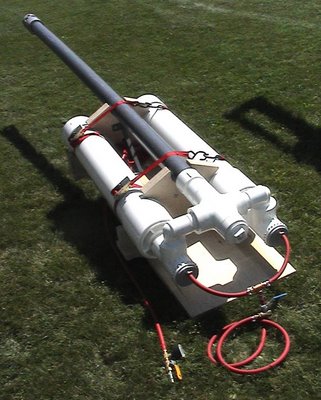
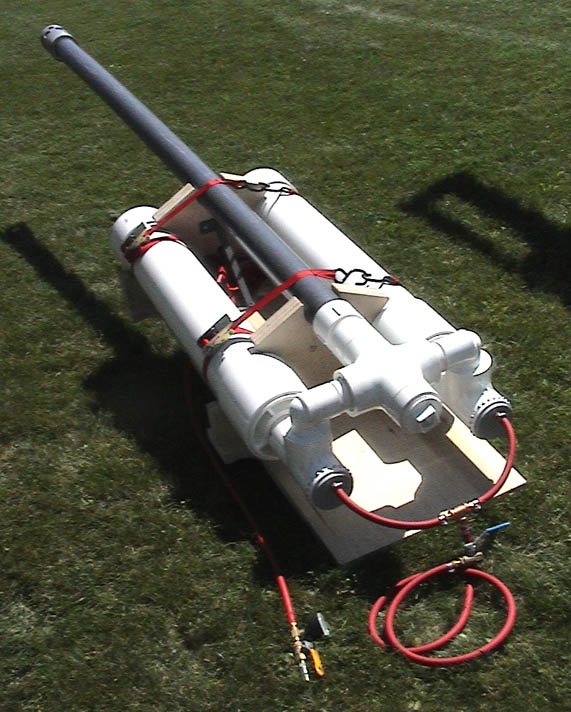
make your own (potato) bazooka
pretty sweet, right? it's a big one, to be sure. check out the DIY directions to make your own spudgun: http://www.spudtech.com/content.asp?id=5
Wednesday, November 08, 2006
ah, my dream briefly deferred- this might pump you up like it did me
http://www.permaculture.com/permaculture/About_Permaculture/food.shtml
by David Blume
I wrote this in response to a post to the bioregional listserve from a woman at ATTRA who said something like "Of course you couldn't feed the world with such a hippy-dippy, hunter-gatherer, landscape system like permaculture." Well that got me a little steamed, so this is what I wrote.
Dear Folks,
I would like to inject some real world experience into this otherwise abstract discussion of food and permaculture.
In addition to being an ecological biologist, a permaculture production food farmer for 9 years, and an expert on biomass fuels, I have also been teaching permaculture since 1997 and have worked in many countries on food/energy production design issues. I have certified more than 400 people in permaculture design since 1997. For more info on this see my site at www.permaculture.com
So in light of my experience I have a couple of things to say. Let us dispense, for the moment only, with the talk of hunter-gatherer models since, to return to that state or to imitate it with design would meet limited acceptance. This is not the core design goal of permaculture although some of our small scale subsistence agriculture designs vaguely look like a hunter-gatherer paradise (i.e. it never existed like this in nature.) The issue of private property as we now define it also complicates that model. We are living in an agricultural age and permaculture offers huge benefits to both production and subsistence agriculture.
As far as I know I was one of the only farmers fully utilizing permaculture to produce surplus food for sale in the US as a full time occupation. On approximately two acres— half of which was on a terraced 35 degree slope—I produced enough food to feed more than 300 people (with a peak of 450 people at one point), 49 weeks a year in my fully organic CSA on the edge of Silicon Valley . If I could do it there you can do it anywhere.
I did this for almost nine years until I lost the lease to my rented land. My yields were often 8 times what the USDA claims are possible per square foot. My soil fertility increased dramatically each year so I was not achieving my yields by mining my soil. On the contrary I built my soil from cement-hard adobe clay to its impressive state from scratch. By the end I was at over 22% organic matter with a cation exchange capacity (CEC) of over 25. CEC is an indirect measure of soil humus or the ability of the soil to hold nutrients available to crops. The higher the number the more nutrients are stored and available. For reference, most Class I commercial agricultural soil is lucky to hit 2% organic matter—the dividing line between a living and dead soil—with a CEC around 5.
At most times I had no more than half of my land under production with the rest in various stages of cover cropping. And I was only producing at a fraction of what would have been possible if I had owned the land and could have justified the investment into an overstory of integrated tree, berry, flower and nut crops along with the various vegetable and fruit crops. The farm produced so much income that I was routinely in the top 15% of organic farms in California (which has over 2000 organic farms) in most years on a fraction of the land that my colleagues were using. I grew over 45 different kinds of crops so my financial success cannot be attributed to growing a few high value crops like Yuppie Chow (salad mix).
Unlike other organic farmers, I almost never used even organic pesticides on my farm. The permaculture ecosystem I designed was so self-managing and self-maintaining with natural controls such as carnivorous insects, toads, lizards, snakes, owls, bats, and other allies, that it was rare that I needed to intervene (I can count the times on one hand that I intervened over 9 years). On the few occasions I did, I used coffee solution made from waste caf é coffee. You didn't think plants made caffeine to get you high did you? Caffeine is an extremely effective natural insecticide, which degrades in the sunlight or air in about 24 hours after use.
On the subsistence agriculture level, we permies regularly have designed productions systems around the world, which feed everyone living in a given house within a 50-foot radius of the house. This rule of thumb holds pretty well because the more folks who live there, the bigger the house, the larger the surface area, so no more than 50 feet is really necessary.
The math is easy. With a polyculture, yields of 3-10 pounds of food per square foot are easy to come up with in most climates. For comparison, commercial agriculture in California , which is way inefficient, routinely runs about 1.5-2.5 pounds per square foot per year across a wide variety of crops. People need to eat about two pounds of mixed food a day if active, or around 750 pounds a year. In a good but somewhat sloppy design, you need about 500 square feet per person MAXIMUM. In a very good design, 200 square feet will do the job. If your diet is heavy on grain you'll need more space but not an astronomical amount. Utilize a greenhouse to extend seasons and exchange air rich in carbon dioxide from chicken houses or human houses, which otherwise would go to waste, and yields ratchet up even more. Take a little more space and include ducks and aquaculture into the mix and the yields become quite diverse and substantial. This sort of system is typical in Vietnam now and there is no longer any measurable hunger there. Wouldn't it be nice if the US could do that with its "superior" first world agricultural system?
Can't do this on a commercial scale? Tell that to Archer Daniels Midland who operates many acres of greenhouses in Decatur using partially integrated production of fish, lettuce and other vegetables using waste carbon dioxide, grain by-products and other by-products from its 100-million gallon per year alcohol fuel production facility, while delivering these profitable agricultural products in trucks running on biodiesel (made from the corn and soybeans they process). This qualifies as commercial scale, very rudimentary permaculture that is wildly profitable and productive.
As a reality check, I'd like to remind everyone that in the 1850's, prior to refrigerated transport, New York City supplied all its food for a population of over a million from within 7 miles of the borders of the city. (It wasn't worth the cost of horse feed and time to go further than 7 miles to export food into the city). No one would discount a system of community food security for one million people as non-commercial.
There are two main reasons known for the dramatically increased productivity of a polyculture?\the benefit of mycorhyzzal symbiosis (which is destroyed in chemical agriculture) and less solar saturation. Solar saturation is the point at which a plants' photosynthetic machinery is overwhelmed by excess sunlight and shut down. In practice, this means that most of our crop plants stop growing at about 10am and don't start again until about 4 in the afternoon. Various members of a polyculture shade each other, preventing solar saturation, so plants metabolize all day. Polyculture as we pursue in permaculture uses close to 100% of the sunlight falling on its mixed crops. Monoculture rarely can use more than 30% of the total sunlight received before saturation. How long could you run any business without external support at 30% efficiency? When you look at a simple Mexican permaculture example, growth of the three sisters of corn, beans and squash (not even counting the 200 vegetables of various sorts growing in the shade of the sisters) you get close to 90% solar efficiency. When you total up the pounds of food from a Mexican acre you get FAR MORE FOOD than the highest yielding nitrogen soaked Iowa cornfield. This is the myth of the green revolution; that the highest total food yields occur in chemical monoculture.
Enough of this. The argument that we don't have enough food to go around is specious anyway. We currently produce more than twice the amount of food we need to feed everyone, even with the extremely inefficient model of monoculture. What starving people lack is money to buy food which is not considered a right but a commodity. Even being able to buy the food isn't a guarantee of access. Midwesterners find it cheaper to burn 5 cent a pound corn in stoves for heat even though Mexican families are willing to pay up to $1 a pound for corn to feed their family.
So you say, "Well if you're such a wiseguy and you obviously would make so much more money from the greater yields of a simple three crop permaculture system, why don't corporations in the Midwest do it to make more money?" This gets to the core of the problemw—hich is not population/resources and/or biological models of overpopulation which typically apply to wild animals.
Capitalism is concerned with more than just making money. The reason why monocultures are favored by corporations EVEN THOUGH THEY ARE THE LEAST EFFICIENT WAY OF PRODUCING FOOD in pounds of food per acre is that it can be done with the least amount of labor. To harvest the three sisters you would need a digital harvester—i.e. two hands—not a combine. Even though the increased labor would be totally justified by the increased profit, corporations are totally allergic to dealing with labor. Labor is messy. It organizes, it wants a fair share of the profit, cities want tax money to pay for worker habitat infrastructure and other pesky things that corporations will avoid at all costs. Our current form of agribusiness is a textbook case of design maximizing the advantage of capital to the disadvantage of labor facilitated by the artificially low cost of energy.
The other reason is control of the market. It is now estimated that 80 percent of the world's arable (read European-style plowed) agricultural land is now in the hands of multi-nationals. It has served their needs to keep productivity low to make it possible to get a hold of as much of the means of production as possible. Farmers who are barely making a living sell their land for a fraction of those making a good profit. Midwest corn farmers generally net only about $50-75 per acre on corn on a gross income of $300 per acre.
My discussion above is not to be taken as a suggestion that population growth is not a problem, it is. So let me make a quick comment on population, from a designer's point of view, which is totally related to the structural issues above. I dare anyone to find an example in which population is stable yet there is no system for security in old age. It has been shown in countless studies that the ONLY consistent reason why population stabilizes is that people know they will have security in their old age. At that point they stop having excess children. Why? It has absolutely nothing to do with the biological resource-population relationships. We are not wild animals and have markedly different behavior. In a developing country, or any country for that matter, without a secure social security system for the aged, you need at least two kids to support each elderly adult. In virtually every case studied where stabilization of social systems occurred, women immediately find systems to end unwanted pregnancy. Herbal indigenous methods for ending fertility are known all over the world. In my own Italian heritage—hardly a herb-oriented aboriginal tribe, even into the 1900's, utilized ergot obtained from the local apothecary to end unwanted pregnancy.
So structural adjustment—the neoliberal formula the World Bank and IMF impose on the developing world—ensures population growth. By intentionally eliminating a secure social safety net as a condition of borrowing money, population growth—and therefore market growth for various consumer goods—continues to grow. Therein lies the rub. If population doesn't continue to grow, capitalists rapidly run out of customers. Can't let that happen now can we?
Permaculture design offers an alternative security for old age when the family has even a little land. In the Deccan desert of India , where there is huge success with permaculture turning hundreds of square miles of man-made desert back into productive designed rain forest, there is a saying: "Trees are better than sons." Sons might take care of you in your old age but income or trade from your productive trees (food, timber and fuel) definitely will. This approach offers families security to limit population growth and takes the supply of old age security back into the people's hands.
Restorative agriculture?\which goes far beyond sustainable agriculture—depends on solar energy replacing fossil fuel use. Buckminster Fuller and I discussed this back in 1983 when he wrote the foreword for my book Alcohol Can Be A Gas!, that accompanied my ten part PBS television series at that time. (Alcohol is a virtually pollution free engine fuel which is superior in almost every way to gasoline.) World photosynthesis in its fully undesigned state, produces biomass in wasteful agriculture and in the wild which far exceeds human need. Our analysis shows that world biomass photosynthesis produces between 6 and 15 times what we used to power every human need every year, including food, electricity, transportation, and heat.
In a designed system, especially a permaculturally-designed system, we could increase the biomass produced by an order of magnitude and in so doing supply all our needs in a much smaller footprint. For instance, you only get about 200 gallons per acre of alcohol fuel from corn, but 1000 gallons from sugar beets, 1200 from Jerusalem Artichokes, 1500 gallons from annual sugar cane in southern states and a variety of other crops which, when properly designed for climate, might yield 2500 gallons per year from two crop cycles. This would be done while increasing soil fertility and providing all the animal food we need as a by-product (replacing the corn which largely goes for animal feed now) at a fraction of the energy cost of corn-soybean agribusiness. This is all possible right now without any new technology.
The Department of Energy-sponsored program to reduce the cost of cellulose-dissolving enzymes. Soon, yields based on that carbohydrate (cellulose) rather than the relatively scarce starch or sugar carbohydrate scenarios described above will ratchet up cost-effective yield another order of magnitude. (We could do it right now with current technology but the fuel would be about $1.65/gallon wholesale). Once again this is just scratching the surface.
I could go on for two weeks non-stop about this?\my colleagues and I do so in my permaculture design courses. The point is that although humans are great at creating deserts and poverty, we also have the incredible capacity to design ecological systems that work for everyone—even some corporations. The argument that we can't produce enough ecologically is, at its source, promoted by corporations who benefit from a view of scarcity and limited resources which they control. Their constant cry is TINA "There Is No Alternative". Right, and the wizard says, "Pay no attention to the man behind the curtain!"
Around the world people are demonstrating that, not only are there alternatives, there are alternatives that allow us all to take care of each other and the rest of the species we live with, and to direct surpluses from our designs back to this care. These are the three main tenets of Permaculture design. We aren't waiting for governments, corporations, or bureaucracies to solve the world's problems. We will do it with or without their help. We are already doing it and no one can stop us because we can't be forced to buy what we don't need anymore. Since few of us in permaculture education are hired by anyone in business or government, we can't be fired or threatened.
I like to say, if you want to end transnational capitalism, (the very opposite of bioregionalism), then stop giving them your capital. To do that you need to start producing what you need—plus some surplus for others—bioregionally and I would respectfully suggest that permaculture design is a good tool to begin that process.
by David Blume
I wrote this in response to a post to the bioregional listserve from a woman at ATTRA who said something like "Of course you couldn't feed the world with such a hippy-dippy, hunter-gatherer, landscape system like permaculture." Well that got me a little steamed, so this is what I wrote.
Dear Folks,
I would like to inject some real world experience into this otherwise abstract discussion of food and permaculture.
In addition to being an ecological biologist, a permaculture production food farmer for 9 years, and an expert on biomass fuels, I have also been teaching permaculture since 1997 and have worked in many countries on food/energy production design issues. I have certified more than 400 people in permaculture design since 1997. For more info on this see my site at www.permaculture.com
So in light of my experience I have a couple of things to say. Let us dispense, for the moment only, with the talk of hunter-gatherer models since, to return to that state or to imitate it with design would meet limited acceptance. This is not the core design goal of permaculture although some of our small scale subsistence agriculture designs vaguely look like a hunter-gatherer paradise (i.e. it never existed like this in nature.) The issue of private property as we now define it also complicates that model. We are living in an agricultural age and permaculture offers huge benefits to both production and subsistence agriculture.
As far as I know I was one of the only farmers fully utilizing permaculture to produce surplus food for sale in the US as a full time occupation. On approximately two acres— half of which was on a terraced 35 degree slope—I produced enough food to feed more than 300 people (with a peak of 450 people at one point), 49 weeks a year in my fully organic CSA on the edge of Silicon Valley . If I could do it there you can do it anywhere.
I did this for almost nine years until I lost the lease to my rented land. My yields were often 8 times what the USDA claims are possible per square foot. My soil fertility increased dramatically each year so I was not achieving my yields by mining my soil. On the contrary I built my soil from cement-hard adobe clay to its impressive state from scratch. By the end I was at over 22% organic matter with a cation exchange capacity (CEC) of over 25. CEC is an indirect measure of soil humus or the ability of the soil to hold nutrients available to crops. The higher the number the more nutrients are stored and available. For reference, most Class I commercial agricultural soil is lucky to hit 2% organic matter—the dividing line between a living and dead soil—with a CEC around 5.
At most times I had no more than half of my land under production with the rest in various stages of cover cropping. And I was only producing at a fraction of what would have been possible if I had owned the land and could have justified the investment into an overstory of integrated tree, berry, flower and nut crops along with the various vegetable and fruit crops. The farm produced so much income that I was routinely in the top 15% of organic farms in California (which has over 2000 organic farms) in most years on a fraction of the land that my colleagues were using. I grew over 45 different kinds of crops so my financial success cannot be attributed to growing a few high value crops like Yuppie Chow (salad mix).
Unlike other organic farmers, I almost never used even organic pesticides on my farm. The permaculture ecosystem I designed was so self-managing and self-maintaining with natural controls such as carnivorous insects, toads, lizards, snakes, owls, bats, and other allies, that it was rare that I needed to intervene (I can count the times on one hand that I intervened over 9 years). On the few occasions I did, I used coffee solution made from waste caf é coffee. You didn't think plants made caffeine to get you high did you? Caffeine is an extremely effective natural insecticide, which degrades in the sunlight or air in about 24 hours after use.
On the subsistence agriculture level, we permies regularly have designed productions systems around the world, which feed everyone living in a given house within a 50-foot radius of the house. This rule of thumb holds pretty well because the more folks who live there, the bigger the house, the larger the surface area, so no more than 50 feet is really necessary.
The math is easy. With a polyculture, yields of 3-10 pounds of food per square foot are easy to come up with in most climates. For comparison, commercial agriculture in California , which is way inefficient, routinely runs about 1.5-2.5 pounds per square foot per year across a wide variety of crops. People need to eat about two pounds of mixed food a day if active, or around 750 pounds a year. In a good but somewhat sloppy design, you need about 500 square feet per person MAXIMUM. In a very good design, 200 square feet will do the job. If your diet is heavy on grain you'll need more space but not an astronomical amount. Utilize a greenhouse to extend seasons and exchange air rich in carbon dioxide from chicken houses or human houses, which otherwise would go to waste, and yields ratchet up even more. Take a little more space and include ducks and aquaculture into the mix and the yields become quite diverse and substantial. This sort of system is typical in Vietnam now and there is no longer any measurable hunger there. Wouldn't it be nice if the US could do that with its "superior" first world agricultural system?
Can't do this on a commercial scale? Tell that to Archer Daniels Midland who operates many acres of greenhouses in Decatur using partially integrated production of fish, lettuce and other vegetables using waste carbon dioxide, grain by-products and other by-products from its 100-million gallon per year alcohol fuel production facility, while delivering these profitable agricultural products in trucks running on biodiesel (made from the corn and soybeans they process). This qualifies as commercial scale, very rudimentary permaculture that is wildly profitable and productive.
As a reality check, I'd like to remind everyone that in the 1850's, prior to refrigerated transport, New York City supplied all its food for a population of over a million from within 7 miles of the borders of the city. (It wasn't worth the cost of horse feed and time to go further than 7 miles to export food into the city). No one would discount a system of community food security for one million people as non-commercial.
There are two main reasons known for the dramatically increased productivity of a polyculture?\the benefit of mycorhyzzal symbiosis (which is destroyed in chemical agriculture) and less solar saturation. Solar saturation is the point at which a plants' photosynthetic machinery is overwhelmed by excess sunlight and shut down. In practice, this means that most of our crop plants stop growing at about 10am and don't start again until about 4 in the afternoon. Various members of a polyculture shade each other, preventing solar saturation, so plants metabolize all day. Polyculture as we pursue in permaculture uses close to 100% of the sunlight falling on its mixed crops. Monoculture rarely can use more than 30% of the total sunlight received before saturation. How long could you run any business without external support at 30% efficiency? When you look at a simple Mexican permaculture example, growth of the three sisters of corn, beans and squash (not even counting the 200 vegetables of various sorts growing in the shade of the sisters) you get close to 90% solar efficiency. When you total up the pounds of food from a Mexican acre you get FAR MORE FOOD than the highest yielding nitrogen soaked Iowa cornfield. This is the myth of the green revolution; that the highest total food yields occur in chemical monoculture.
Enough of this. The argument that we don't have enough food to go around is specious anyway. We currently produce more than twice the amount of food we need to feed everyone, even with the extremely inefficient model of monoculture. What starving people lack is money to buy food which is not considered a right but a commodity. Even being able to buy the food isn't a guarantee of access. Midwesterners find it cheaper to burn 5 cent a pound corn in stoves for heat even though Mexican families are willing to pay up to $1 a pound for corn to feed their family.
So you say, "Well if you're such a wiseguy and you obviously would make so much more money from the greater yields of a simple three crop permaculture system, why don't corporations in the Midwest do it to make more money?" This gets to the core of the problemw—hich is not population/resources and/or biological models of overpopulation which typically apply to wild animals.
Capitalism is concerned with more than just making money. The reason why monocultures are favored by corporations EVEN THOUGH THEY ARE THE LEAST EFFICIENT WAY OF PRODUCING FOOD in pounds of food per acre is that it can be done with the least amount of labor. To harvest the three sisters you would need a digital harvester—i.e. two hands—not a combine. Even though the increased labor would be totally justified by the increased profit, corporations are totally allergic to dealing with labor. Labor is messy. It organizes, it wants a fair share of the profit, cities want tax money to pay for worker habitat infrastructure and other pesky things that corporations will avoid at all costs. Our current form of agribusiness is a textbook case of design maximizing the advantage of capital to the disadvantage of labor facilitated by the artificially low cost of energy.
The other reason is control of the market. It is now estimated that 80 percent of the world's arable (read European-style plowed) agricultural land is now in the hands of multi-nationals. It has served their needs to keep productivity low to make it possible to get a hold of as much of the means of production as possible. Farmers who are barely making a living sell their land for a fraction of those making a good profit. Midwest corn farmers generally net only about $50-75 per acre on corn on a gross income of $300 per acre.
My discussion above is not to be taken as a suggestion that population growth is not a problem, it is. So let me make a quick comment on population, from a designer's point of view, which is totally related to the structural issues above. I dare anyone to find an example in which population is stable yet there is no system for security in old age. It has been shown in countless studies that the ONLY consistent reason why population stabilizes is that people know they will have security in their old age. At that point they stop having excess children. Why? It has absolutely nothing to do with the biological resource-population relationships. We are not wild animals and have markedly different behavior. In a developing country, or any country for that matter, without a secure social security system for the aged, you need at least two kids to support each elderly adult. In virtually every case studied where stabilization of social systems occurred, women immediately find systems to end unwanted pregnancy. Herbal indigenous methods for ending fertility are known all over the world. In my own Italian heritage—hardly a herb-oriented aboriginal tribe, even into the 1900's, utilized ergot obtained from the local apothecary to end unwanted pregnancy.
So structural adjustment—the neoliberal formula the World Bank and IMF impose on the developing world—ensures population growth. By intentionally eliminating a secure social safety net as a condition of borrowing money, population growth—and therefore market growth for various consumer goods—continues to grow. Therein lies the rub. If population doesn't continue to grow, capitalists rapidly run out of customers. Can't let that happen now can we?
Permaculture design offers an alternative security for old age when the family has even a little land. In the Deccan desert of India , where there is huge success with permaculture turning hundreds of square miles of man-made desert back into productive designed rain forest, there is a saying: "Trees are better than sons." Sons might take care of you in your old age but income or trade from your productive trees (food, timber and fuel) definitely will. This approach offers families security to limit population growth and takes the supply of old age security back into the people's hands.
Restorative agriculture?\which goes far beyond sustainable agriculture—depends on solar energy replacing fossil fuel use. Buckminster Fuller and I discussed this back in 1983 when he wrote the foreword for my book Alcohol Can Be A Gas!, that accompanied my ten part PBS television series at that time. (Alcohol is a virtually pollution free engine fuel which is superior in almost every way to gasoline.) World photosynthesis in its fully undesigned state, produces biomass in wasteful agriculture and in the wild which far exceeds human need. Our analysis shows that world biomass photosynthesis produces between 6 and 15 times what we used to power every human need every year, including food, electricity, transportation, and heat.
In a designed system, especially a permaculturally-designed system, we could increase the biomass produced by an order of magnitude and in so doing supply all our needs in a much smaller footprint. For instance, you only get about 200 gallons per acre of alcohol fuel from corn, but 1000 gallons from sugar beets, 1200 from Jerusalem Artichokes, 1500 gallons from annual sugar cane in southern states and a variety of other crops which, when properly designed for climate, might yield 2500 gallons per year from two crop cycles. This would be done while increasing soil fertility and providing all the animal food we need as a by-product (replacing the corn which largely goes for animal feed now) at a fraction of the energy cost of corn-soybean agribusiness. This is all possible right now without any new technology.
The Department of Energy-sponsored program to reduce the cost of cellulose-dissolving enzymes. Soon, yields based on that carbohydrate (cellulose) rather than the relatively scarce starch or sugar carbohydrate scenarios described above will ratchet up cost-effective yield another order of magnitude. (We could do it right now with current technology but the fuel would be about $1.65/gallon wholesale). Once again this is just scratching the surface.
I could go on for two weeks non-stop about this?\my colleagues and I do so in my permaculture design courses. The point is that although humans are great at creating deserts and poverty, we also have the incredible capacity to design ecological systems that work for everyone—even some corporations. The argument that we can't produce enough ecologically is, at its source, promoted by corporations who benefit from a view of scarcity and limited resources which they control. Their constant cry is TINA "There Is No Alternative". Right, and the wizard says, "Pay no attention to the man behind the curtain!"
Around the world people are demonstrating that, not only are there alternatives, there are alternatives that allow us all to take care of each other and the rest of the species we live with, and to direct surpluses from our designs back to this care. These are the three main tenets of Permaculture design. We aren't waiting for governments, corporations, or bureaucracies to solve the world's problems. We will do it with or without their help. We are already doing it and no one can stop us because we can't be forced to buy what we don't need anymore. Since few of us in permaculture education are hired by anyone in business or government, we can't be fired or threatened.
I like to say, if you want to end transnational capitalism, (the very opposite of bioregionalism), then stop giving them your capital. To do that you need to start producing what you need—plus some surplus for others—bioregionally and I would respectfully suggest that permaculture design is a good tool to begin that process.
Tuesday, November 07, 2006
against his-story, against leviathan! chapter 2; (Morgan's progress, the first cities with a Lugal) a few personal blurbs
hmm
the Syn Film Festival goin on now. it's all free, and i found the schedule at http://cincinnati.craigslist.org/eve/226450389.html
i broke my foot. again. in the same spot as before. Please share any money producing ideas i could pull off without hurting my busted foot.
if this were a personal conversation, you would at this point be showing extreme tolerance by letting me talk with a mouthful of dumper doven (diven? divine?) avocados and baked tortilla chips. i'm leading the good life!
and that brings me to another point: I am happily in an open/poly relationship now. even if i don't see anyone else, this feels much better. it's better than cheating, which is what one pal told me to do. i guess that's how most folks who get the itch do, but why go in for all the drama?
i just met the older brother of my partner, and he's a neat fella. he started this website, as well as the chaozation one: http://twentythree.us/moving/occulted.htm
and now, chapter 2 of Fredy Perlman's "Against His-story, Against Leviathan!"
2.
An armored one asks: If the Age of Gold was so valuable, so beautiful, so pure, why did people leave it? If the Civilized remember it, why don’t they rush back to it? If it was so comfortable, why don’t farmers throw away their plows and return to digging sticks? (This same questioner also asks: If you’re so smart, why aren’t you rich?)
There are answers to these questions. But the questioner does not want to hear them. He already knows the answer. Humanity left the state of nature because Civilization is a higher stage. (Higher stage of what? The armored one will never tell. He quickly turns to something else.)
The theory of the higher stage is as old as Civilization itself. One of its more influential modern versions originated with a nineteenth century lawyer who lived in upstate New York, Lewis Henry Morgan.
A consultant to speculating businessmen, a Republican politician and a racist, Morgan nevertheless found time to do a study of his neighbors in upstate New York, devastated remains of once-numerous Iroquoian communities. Morgan’s racist predecessors Washington and Jefferson had insisted the Iroquoians were children but Morgan thought the Iroquoians had reached a stage between childhood and adolescence.
Morgan generalized his racism into a ladder, every rung of which gleams with racist polish. He made now effort to disguise his contempt; on the contrary, he flaunted it; such contempt was (and still is) a mark of refinement in America. He named the lowest run, the stage of infancy, Savagery. He named the next rung, the stage of childhood, Barbarism. And of course he named the tops rungs Civilization, the topmost American Civilization. On this topmost rung sat Morgan with the Great White Race. The professors of America were so flattered they elected Morgan president of the American Association for the Advancement of Science.
The professors would later regret their vote. Morgan’s racist ladder was borrowed by the agitator Karl Marx and the revolutionary businessman Friedrich Engels. Marx intends to patch the ladder but never found the time. It was Engels who patched Morgan’s ladder. He didn’t patch much. He borrowed the ladder intact, with all the racist polish of Morgan’s nomenclature: Savagery, Barbarism, etc. Engels patched only the ladder’s summit. He renamed Morgan’s topmost rung, and he placed a yet higher rung above it.
Engels changed the name of Morgan’s Great White Race to Capitalist Class, and on the rung above it he placed the leaders and followers of Marx’s political party. And in this form, Morgan’s racist ladder became the official religion of the USSR, China, Eastern Europe and other lands where the names of the rungs are stuffed into the heads of schoolchildren as a catechism.
Of course as soon as the agitators got hold of the ladder, American professors didn’t want to be caught with their hands on it. They forgot Morgan. (This is easily done in places where memory is at the mercy of publishers of written words.)
But racism did not vanish from America, and Morgan’s ladder was too good a thing to leave to the agitators. The archeologist V.G. Childe, although himself a Marxist, gave the ladder an aura of respectability by filling its rungs with all the latest Positive Evidence. And the ladder came back to America, not quite as an official religion but more as a last resort, as something to use in emergencies. Reference to “the state of nature” always creates emergencies.
The ladder, the theory of higher stages, of course explains why people left the state of nature. That’s what it is designed to do. The title of Engel’s book is The Origin of the Family, Private Property and the State. The explanation is simple, lucid, in fact mechanical, and can be taught in elementary schools. All we have to do is look away from living beings and concentrate on things. The ladder is a thing. So are its rungs. And the connection between lower and higher rungs are also things. They’re devices. Childe misleadingly named his book Man Makes Himself, giving the impression that his subject was a living being. For Childe, Man himself is a thing, a container of objects and devices; Matter is the core and Man the excrescence.
The device responsible for Man’s passage from the rung called Savagery to the rung called Barbarism is a gadget called the Material Conditions, or more fully, the Level of Development of the Productive Forces. This same device is responsible for the passages to all the higher rungs.
Marx and Engels, and also Morgan, lived at a time when the material conditions, literally the ground itself, slipped from under the feet of the former rulers, the hated barons and bishops: capitalist owners of mines and factories were buying up the lands of the aristocrats. Marx and Engels prognosticated that the ground would similarly slip out from under the capitalists, and they projected their wish to the first dawn.
In terms of this projection, Man exists for thousands of generations as a Savage. Then, three hundred or so generations ago, material conditions become favorable for something higher than savagery. These conditions include agriculture, metallurgy, the wheel, etc. Once he has all these things, Man is able to generate a surplus product, a margin. (Turner, too, succumbs to this part of the theory.) This surplus, this margin, is what supports, literally feeds, the brave new world that now becomes possible: kings, generals of armies, slavemasters, bosses of labor gangs. Man had always wanted rulers, permanent armies, slavery, division of labor, but he couldn’t realize these dreams until the material conditions became ripe. And as soon as they did become ripe, all progressive-minded Savages leapt unhesitantly to the higher rung.
(Reader: do me a favor and reexamine the theory of higher stages first. Then tell me if you still consider my caricature exaggerated.)
This theory of higher stages can be taught to small children because it’s a fairy tale. There’s nothing wrong with fairy tales. But the proponents of this one claim it is something else; they are contemptuous of fairy tales.
* * *
The so-called material conditions were nothing but aids to feasting, walking and floating. They were like cains to old men. Their variety and complexity attest to the ingenuity of human beings. But the centrality of such things to us is no proof that human beings in the state of nature revolved around fruits, nuts and canes. Little as we know of their great moments, we do know they were not industrial fairs, celebrations of new inventions, gadget displays. Things may have been useful, but they were trivia compared to the moments when one made contact with the beginning, the source of life, Being itself.
The trivia are ancient, and may have been more varied in the old days than they are now. When fruits matured on high branches, all kinds of hooked poles, ropes and ladders were devised to reach the fruits before monkeys reached them.
People knew themselves as cousins of animals. Many of their implements enabled them to copy the ways of animals. On the banks of rivers and lakes, people devised all types of rafts and canoes so as to float like ducks and swans. They stored nuts for winter use after the manner of squirrels. They scattered seeds after the manner of birds. They wove nets after the manner of spiders. They stalked deer after the manner of wolves. Wolves have strong teeth and jaw. People sharpened sticks and stones. (Our archeologists picture them chipping away, all day long, like zeks. We’re projecting again. Those people were not coerced by what Toynbee calls “impersonal institutions.” They had no reason to go on chipping after it stopped being fun.)
Modern diggers have even unearthed the remains of ancient cities at places in Anatolia and the Levant, places later named Shanidar, Jericho, Catal Hoyuk, Hacilar. At Shanidar the whole community shared a cave as a winter shelter; the cave dwellers used metals. At Jericho people caved themselves in by building a wall, probably to protect themselves from hostile interlopers. These people seem to have done little or no planting. To the north of them were people who planted seeds and herded animals but did not build cities or walls. And across the world from them were the ancestors or predecessors of the Ojibwa, who practiced metallurgy on lake Superior, making beautiful copper ornaments and implements.
None of these people developed “impersonal institutions.” They remained kin. They went on sharing all they had and all they experienced. The copper users of Lake Superior did not plant seeds or herd animals. Perhaps they could have, but they had no earthly need to. They did have dogs. Dogs apparently domesticate themselves, either because of an incomprehensible love for human beings or because of a parasitic urge. But what satisfaction could come from developing strains of parasitic, doglike elk or moose?
The material objects, the canes and canoes, the digging sticks and walls, were things a single individual could make, or they were things, like a wall, that required the cooperation of many on a single occasion. I would guess that the builders of the first Jericho’s walls ceased to be wall-builders the moment they were done; they returned to more important activities. I would even guess they built the wall in order to pursue the more important activities undisturbed.
As for the surplus project, the famous Margin these implements supposedly made possible: Sahlins and others have shown that communities with many implements and communities with few, in lush environments and in harsh ones, were all surrounded by surpluses. After all the people had eaten their fill, after all the insects and birds and animals had eaten their fill, there was still a virtual bounty that fell to earth and fertilized the next spring’s new shoots. Many animals and many people stored what they expected to use during an average winter, but no one hoarded more than that; free people didn’t need to.
* * *
Most of the implements are ancient, and the surpluses have been ripe since the first dawn, but they did not give rise to impersonal institutions. People, living beings, give rise to both. And it is not Man or Mankind who is responsible, but one isolated community, a tiny minority in Toynbee’s words.
Furthermore, this tiny minority does not give rise to such institutions in the most favorable material conditions, say in the lush woodlands around the Great Lakes or the abundant forests of Africa or Eurasia. They do it in the least favorable material conditions, in a fiercely harsh environment.
Diggers will actually unearth and decipher tablets which shed light on some of the first moments of impersonal institutions.
The tablets are in Sumerian, a language that may have originate in Central Asia. The authors are the first literate men. The villages where they live are called Erech, Ur, Eridu, Lagash. The villages are located in the valley between the Tigris and Euphrates rivers. The place will called a Fertile Crescent ages later, to explain why donkeys have tails.
The first tablets don’t speak of the place so favorably. They describe it as a hellish place and make one wonder why those people stay there. They are set on farming in a jungle. The rivers flood yearly, fertilize the valley and turn it into a swamp.
Women plant seeds. One year the flood is so violent it carries off the crop as well as the houses. The following year there’s not enough water, and the plants dry up and die in the burning heat of the sun.
Surely the villagers must start thinking of returning to the more favorable conditions of Central Asia, where they did not have to spend so much time and energy on mere survival, where they had time for more enjoyable activities.
But they are tenacious. The grandmothers call the old men to a council. These men have been dreaming. The women urge the men to dream of a dependable water supply, neither too little nor too much.
The men are undoubtedly offended at being called away from their mental transports for the sake of such trivia. They probably have to be called to a second council and then a third, this last during a famine.
The old men sluggishly respond. They may have seen how beavers assure themselves of a dependable water supply. They dream. They see that what is needed is a dam, canals and drainage ditches. But who is to build these? Certainly not the old men. They are not beavers. They call the young men together and explain the dream.
The young men have been doing nothing at all, so they are eager to show themselves willing and generous givers.
But no one knows how to proceed. The old men may or may not dream up the plans, but they certainly do not supervise the actual doing. They choose a strong young man, a Lugal; they tell him to go look at beavers. The old men then return to their more important philosophical endeavors.
The Lugal, which means strong man in Sumerian, may or may not learn from the beavers, and he may or may not do the planning. He certainly does the supervising. Wasn’t he designated by the elders?
When the ditches and canals are dug, the Lugal returns among his peers, proud but not yet haughty. Nothing has changed yet. Such cooperative ventures were infrequent but not uncommon in communities of kin.
But this is Erech, a place where the gods obviously don’t want people to live. A single flood carries the whole works into the sea. The women call the old men to another council. This time the elders choose a yet stronger young man and urge him to study the beavers more conscientiously or dream more profoundly. And this time the banks and dikes hold, at least initially.
But Erech remains a materially wretched place, and before long the banks begin to crumble. The experienced Lugal is called to repair the banks and dikes. The Lugal and his cousins complain that they should have called a moon sooner, when the banks were still repairable; now they have to build the entire works. This happens twice, at most three times before the Lugal insists on having a seat in the council of elders, so as to have a say in choosing the time to repair dikes.
Springs pass and winters pass, filled with feasts, festivals, dances and games.
The elders of Ur, and even those of Lagash, designate Lugals to go study the irrigation works of Erech.
One elder of Erech and then another die of old age; they are replaced on the council by newcomers.
By now the Lugal is a more experienced elder than the newcomers, and he expresses himself about other things than dikes. He becomes haughty, and his cousins stand behind him. He and they, after all, are the ones who provide Erech with a dependable water supply. The Lugal even dares to tell an old grandmother where not to plant her seeds.
One day the Lugal is found dead, murdered by a deity, a deity known to be in close contact with the insulted grandmother. A new Lugal is chosen, a less haughty one, and the elders are more careful to keep him out of their council.
There is no positive evidence for any of this. The fact is that the Sumerian tablets are mysteriously silent about the deeds of the women and elders at the time of the first Lugals. And as time goes on, the tablet-scribes help people forget that Sumerian women were important, that elders once sat in council, that there was age before the first Lugal.
* * *
But I’ll return to my story.
The people of Ur and those of Lagash have completed their water works. These grow more extensive every year.
One year the drainage ditches of Lagash overflow into Ur’s canals, flooding and ruining Ur’s works.
This so infuriates the Lugal of Ur, called Urlugal, that he leads his spear-armed cousings against those of Lagash. The enraged youth of Ur destroy their neighbors’ water works and pursue fleeing Lagash people to the desert. In their rage they murder several foreigners, desert nomads whose paths they cross.
When at last the besieged Lagashians beg for an end to the violence, the victors, Urlugal at their head, impose a fiendishly heavy burden on the defeated. The man of Ur demands reparations from the Lagashians, who are to rebuild their own waterworks and those of Ur as well. Lagashians unwilling or unable to support such a burden are invited to bring large gifts to the man of Ur, at specified periods.
Urlugal is determined to keep track of all the tribute gifts owed to him, for he’s as tenacious as those ancestors of his who did not abandon the Fertile Crescent. To keep track of the gifts and givers, he sends one or two of his cousins to Erech to study the marks some of Erechlugal’s men have been making on clay tablets to keep track of the best times to repair dikes. Urlugal’s men soon make clay tablets of their own, and onto these tablets they chisel wedge-shaped marks to signify the names of those in Lagash who still owe tribute gifts, and the amounts.
All these events do not happen within a single Urlugal’s lifetime. Urlugal is only one of the names of Ur’s Lugals. The Sumerians have hundreds, perhaps thousands of Lugals,, and the scribes invent yet more names of Lugals to fill the time between themselves and the first dawn. For the Sumerians, the interval between themselves and the Beginning is not as brief as it will later become for Christians. The tenacious Sumerians reckon in millions.
I latched on to Urlugal because of his telling name, so I’ll stick with him. He’ still collecting tribute from Lagash. His nephews are still having a ball supervising the canal work of their neighbors instead of doing it themselves.
Now alarming news arrives. Some of Urlugal’s cousins went hunting, perhaps in the forests of Lebanon. One of them returns, with barely enough life in him to tell the tale. The hunters were attacked by spear-armed nomads; all were killed but the teller. The attackers are probably kin of the foreigners killed by Urlugal’s men during the foray against Lagash.
Urlugal immediately prepares his strongest cousings against the murderous foreigners. The elders try to cool the hotheads, suggesting that the foreigners were avenging the victims of Urlugal’s initial raid, and another raid will only lead to more reprisals. But the hotheads will not be stopped.
Urlugal and his cousins, still flushed by their victory over Lagash, set out towards the Lebanon forest. They actually find a camp of foreigners. They raze it to the ground and murder most of the nomads. On their way back with the captured animal herds, the men of Ur are attacked by another band of foreigners. The forest seems to teem with foreigners.
Urlugal and many of his cousins are killed. The survivors abandon their loot and flee back to Ur in disarray.
All Ur is in a rage. Someone reminds the angry crowd of the elders’ prediction and he’ immediately killed. The survivors and their cousins clamor for the appointment of the strongest and most determined among them as Lugal. The victors over Lagash will not be bested by mere foreigners, they will not be flies to spiders who live in no cities and plant no seeds. The council of elders, beset by the entire town’s rage, hesitantly appoints the new Lugal.
The enraged warriors set out against the foreigners. They send scouts ahead so as not to be trapped in another ambush. They transport their supplies as well as Lugal himself on wheeled carriages; the Lugal can thus save his strength for the actual battle, and the men from Ur can move faster than any foreigners. They find several camps of nomads and raze every one to the ground.
They return to Ur- this time not only with captive herds but with captive foreigners as well. The returning warriors are embraced by their worried kin. For a fornight all Ur is taken up with feasts, dances, celebrations. The elders, men and women, prepare generous offerings to the spirits and powers who made victory possible. Special offerings are made to the Lugal’s deity.
When the celebrations end, the flushed warriors, the heroes, are not about to return to repairing the canals. The stint of the Lagashians is about to end. In fact, the Lagashians are complaining that they’ve already done more for Ur than they ever agreed to do. Who’ll do the repairing now? The Lugal’s cousins had long been supervising defeated Lagashians and they’re not pleased by the prospect of replacing the defeated.
The captured foreigners are put to work on the canals. Each of the Lugal’s cousins is now a Lugal, a supervisor. The Sumerian word is Ensi. This is a sub-Lugal, an assistant to the Lugal, a boss but not the boss.
Nomads continue to harass Ur’s hunters and travelers. But news of their raids is no longer alarming. The Lugal leads frequent expeditions against the unintelligible Semitic-speaking foreigners.
The elders no longer object to these expeditions, prudently confining themselves to visionary and philosophical activities. Occasionally the Lugal consults an old man or woman about the likelihood of victory, but otherwise he keeps a respectful distance from them.
The Lugal now looks forward to these expeditions, for each new raid brings new foreigners to Ur. There are now enough foreigners in Ur to repair canals in every season. Soon the captives from the earlier expeditions are recruited to expeditions against new raiders.
Now foreigners do not only repair dikes. They also repair the houses of old men and women. They do the Lugal’s chores and soon the chores of Ensis.
Sumerian women still give birth to the plants in the field, but now they do this by maintaining close and continual contact with Earth and with the spirits responsible for nurturing the plants. The actual scattering of seeds is done by captured foreigners.
And who are these foreigners? Surely we can recognize them as the first zeks! They are workers, proletarians, full-time laborers. The Sumerian language comes from another age. Just as it has no word like King, Ruler, Emperor, President, it has no word like Zek, Worker, Slave. Sumerians continue to call the lugal Lugal, and they continue to call the foreigners Foreigners. But in an incredibly short time, Ur abandons the exotic world of seers and visions.
* * *
I’ve been using the present tensej. Ur is Now. It is not exotic at all. It is our world.
What happened?
I’ve already disposed of the Marxist explanation. Favorable material conditions did not give rise to the first Lugal of Erech. Material conditions remained what they were for generations, and the people of Erech had no access to the best of them. Material conditions begin to change only after the first Lugal, and from then on they change fast.
Pierre Clastres will say there was a revolution- not a material but a political revolution. This is a good way to put it, but it is true only in retrospect. The Sumerians obviously undergo a great change; we can call this a revolution, but they do not experience it as one.
From the standpoint of the Sumerians, nothing changes. In a sense they never leave the state of nature. This is probably what accounts for the exoticism that will continue to cling to what we will call “early civilizations.” The Sumerains haven’t become zeks. They’re still possessed. Sumerian women still give birth, not as machines for the production of soldiers and workers, but as living beings in close contact with the sources of Being. Sumerian men, especial oder ones, still seek contact with the spirits of the winds, the clouds, even of the sky itself. In fact, they devote themselves to their searches more completely than they ever could before. Now all their energies are devoted to the dances, festivals and ceremonies. They no longer have to concern themselves with the trivia of material survival. The trivia are all done for them.
Furthermore, the Lugal and his men bring far more generous gifts to the spirits than could ever be given before. The Lugal’s men have even built permanent shrines to all the spirits and powers, incredibly beautiful shrines, and around the shrines they’ve placed gardens and filled them with all the creatures of the deserts and forests.
Never before have people show such homage, such respect, to the beings responsible for life. It is true that the Lugal builds the greatest shrine to his own deity. This is obviously presumptuous on the haughty Lugal’s part, since he cannot know that the spirits accecpt the hierarchic arrangement into which he places them. This is a type of revolution. But the Sumerians are not now going to turn against the Lugal for his haughtiness. They’ve gotten used to it, and instead of irking them, it now makes the smile with a certain pride. It is thanks to him that they can devote themselves so completely to the wellbeing of their city.
I have to admit to my questioner that the Sumerians would not part with a single of the new implements. They do not long to return to the timeless Golden Age. They are in the Golden Age, more so now than ever before.
But the golden Sumerians are no longer all of Sumer. In fact, in some later scholarly accounts, the golden Sumerians will not even exist. They will be dismissed with a single word. The word is Temple. The devotees of Inanna, the loving daughter of the Moon; the communicants with Anu, the spirit of the sky, are not the users of the new implements. They are not he administrators of the irrigation works, the builders of the great palaces, the heroes of military encounters. They are what we will cal Priests and Priestesses, oracles and diviners. All that is left in Sumer from the state of nature has shrunken to what we will call Religion.
Perhaps some of the women who no longer scatter seeds, perhaps some of the men who now longer hunt or herd, feel some nostalgia for the old days. But there is no evidence of a “back to the land” movement among the Sumerian clergy. The scribes who chisel the tablets are the Lugal’s hired men; they are not hired to record the nostalgia of the clergy. The only clues we have are the gardens which the Lugal’s men build and fill for the Temple’s residents.
These Temple gardens are mysteriously lush for small towns surrounded by non-urban vistas and in walkin distance from forests and mountains—and the Sumerians are such good walkers. Could it be, as Turner will suggest, that the world outside the city is already becoming a wilderness?
We should look carefully. The world outside Ur is not the wilderness our word will designate. Their wilderness clearly is not the forest or desert, the plants or animals, since the nature-loving Temple residents have all these brought into the city.
Could it be that their wilderness is the wilderness created by the Lugal and his men: the battlefields surrounding all of Sumer’s towns, the setting of raids and counter-raids, the scenes of torture, slaughter and capture? A priestess who wanted to commune with the Moon by a forest pond would have to set out with an armed escort. It has become more practical to bring a shrunken pond and forest into the precincts of Ur.
If the former free community has shrunken to a Temple, an excrescence of that community has grown extremely large, for the Temple is now surrounded by a bustling city, almost modern in every way except in its relgion—perhaps not altogether modern but at least perfectly intelligible to us.
There are rich and there are poor, since the families of Ensis are no kin of the foreigners and share nothing with them. There is a market, since the well-to-do no longer gather grow or hunt their own food. There are generals and their soldiers. There are record-keepers and there is even a school for scribes. And it all runs like clockwork.
Let’s look more closely. If the people in the Temple are golden, those outside are of baser metals.
The Semitic-speaking members of the labor gangs, married and with one or more children, not quite Sumerianized yet, remember better days. It might not be altogether insane to suppose that these first zeks love their Ensis no better than later zeks will love theirs. Some of the victories celebrated on the tablets are against foreigners already in Sumer; in other words, they are victories over rebelling zeks.
The foreigners are maltreated, overworked and despised. They are neither free nor whole. They are the dispossessed. Some of their children might face a brighter future, especially those who go to war and butcher other foreigners bravely enough. The Sumerians have not yet progressed to the higher stage of hereditary misery. Even so, the lot of the Sumerian zeks is in no sense golden.
Rousseau, and before him de la Boetie, will wonder about situations like these. In any given labor gang, there are many zeks and only one Ensi. What keeps the zeks from ganging up against the Ensi? Why do people reproduce a miserable daily life?
Let’s glance at the Ensis. They are materially well off. But they are beset by fears, and at least on Ensi is paranoid. He’ afraid to be murdered by the zeks in his gang. He has already executed several conspirators. He’ afraid word of his incompetence might reach the LUgal. And, the gods forbid! He suspects someone in the Temple nurses a grudge against him.
There’s something else about the Ensi. His zeks aren’t free or whole. But neither is he. Except when they rise, or gang up against an Ensi, the zeks are not determined by their own nature or being, by their own choices or wishes. The tasks they spend their days on are not their own. But those tasks are not the Ensi’s either.
The Ensi knows of a work gange whose supervisor was murdered by zek conspirators. The murdered man was replaced by a man with a different outlook and altogether different interests. Yet once he was supervisor, the new man did the very same things as the murdered supervisor, and in almost the same manner.
Strange thoughts come to the Ensi’s mind. Could it be, he wonders, that the only man in Ur who is his own man is the Lugal? Now he wonders if even this is true. He has heard of a town whos Lugal was killed along with most of his Ensis in an uprising of zeks. When the Ensi first heard the story, he wasn’t surprised that there was an uproar, that many of the activities which emanated from the Lugal’s will came to a standstill. But now he remembers that very few activities came to a complete halt, even during the interregnum between Lugals. He even remembers that no council of elders replaced the dead Lugal; the elders stayed in the Temple and locked its gates. Many of the town’s activities, important ones and that, went on as before, like the clockwork of the Ensi’s descendants.
Yet stranger thoughts come to the Ensi. It seems to him that the town has a will of its own. But he knows it doesn’t. The only one in town with a will is the Lugal. The Ensis only execute the Lugal’s will. And if the zeks have a will at allk, it is a will to break out. The Ensi concludes that it is pointless to think. Thinking is the job of priests and oracles.
One of the Ensi’s distant descendants in a much later Ur, a scribe called Thomas Hobbes, will know that the Ensi is trying to understand Civilization with the ideas that come from the state of nature. This Hobbes will know that Ur is no longer in the state of nature, it is no longer a community of self-determined human beings.
* * *
Hobbes will know that Ur is no mere city. Ur is a State, maybe even the first State. And a state, Hobbes will say, is an “artificial animal.” It is something brand new, something neither Man nor Nature dreamt of. It is “that great Leviathan called a Commonwealth, or State, in Latin Civitas, which is but an artificial man.”
Like the thinking Ensi, Hobbes will know that this artificial man has no life of its own, and he will ask, “may we not say, that all automata (engines that move by themselves by springs and wheels as doth a watch) have an artificial life?”
The Ensi cannot yet visualize a watch. The more advance Hobbes will no longer be able to visualize nature or human beings. He will ask “what is the heart, but a spring; and the nerves, but so many strings; and the joints, but so many wheels…?” In a world of watches, the Leviathan will not appear as strange to Hobbes as it appears to the Ensi.
Hobbes will picture the Leviathan as an artificial English man: masculine, blond, with a crown on its head, a scepter in one hand and a sword in the other, its body composed of myriads of faceless human beings, zeks.
Hobbes will insist that the Leviathan has the head of a man. He might agree with the yet later poet Yeats that the beast has “a lion body and the head of a man.” But he will insist on the mans head. He will know that the zeks are headless, that they are the springs and strings that operate the body. He will think the monster contains one free and whole man, the Lugal. Hobbes will be able to call the Lugal a King, Monarch, Rulter and other names besides, because his language will have been enriched by the intervening proliferation of Leviathans.
The philosophical Ensi already knows better than Hobbes that the beast has neither the body nor the head of a man, whether English Sumerian. The Ensi knows that even the Lugal, the freest man in Ur, cannot go hunting in the morning, fishing in the afternoon and dancing at night, as his own spirit moves him. He knows of a Lugal who went off huntin only twice, and the second time, while the Lugal was in the woods, his favorite Ensi had replaced him as Lugal, and the former Lugal had to beg for asylum in the neighboring city. The Ensi knows that a Lugal who let himself be determined by his own spirit would quickly be overthrown by Ensis or even zeks, and that even the Temple would be in an uproar.
The Ensi, less advanced than Hobbes, is as yet more familiar with living beings than with springs and watches. He cannot envision the Leviathan wih either a human head or a lion body. He might use Hobbe’s first description and think of the beast as an artificial animal, but no an animal as graceful and limber as a lion.
He might think of it as a worm, a giant worm, not a living worm but a carcass of a worm, a monstrous cadaver, its body consisting of numerous segments, its skin pimpled with spears and wheels and other technological implants. He knows from his own experience that the entire carcass is brought to artificial life by the motions of the human beings trapped inside, the zeks who operate the springs and wheels, just as he knows that the cadaverous head is operated by a mere zek, the head zek.
Among the speculations this Hobbes will give us as offerings to his Ur will be the claim that the zeks actually contracted themselves to imprisonment within the carcass, or as he will put it, that the head made an agreement with the body, if not in Hobbes’ Ur then at least in the original Ur.
The philosophical Ensi, who has by now retired to the Temple, already knows better. He knows the zeks are foreigners who were brough to Ur by force before they even understood the Lugal’s language; the zeks agreed to no contract then, and they haven’t done so since.
The Ensi even remembers that the defeated Lagashians who contracted themselves to repairing Ur’s canals made this agreement only at the point of spears.
Furthermore, no Lugal ever advanced Hobbes’s claim; he would have been laughed out of office. The Lugal knows that the elders didn’t appoint him, since the elders no longer do any appointing; they take care of the shrines. The Lugal claims that his power comes to him from the violent spirit who lodges in the Ziggurat or artificial mountain. This sprawling man-made phallus shape is the read head of the Leviathan, and it made no contracts.
* * *
the Syn Film Festival goin on now. it's all free, and i found the schedule at http://cincinnati.craigslist.org/eve/226450389.html
i broke my foot. again. in the same spot as before. Please share any money producing ideas i could pull off without hurting my busted foot.
if this were a personal conversation, you would at this point be showing extreme tolerance by letting me talk with a mouthful of dumper doven (diven? divine?) avocados and baked tortilla chips. i'm leading the good life!
and that brings me to another point: I am happily in an open/poly relationship now. even if i don't see anyone else, this feels much better. it's better than cheating, which is what one pal told me to do. i guess that's how most folks who get the itch do, but why go in for all the drama?
i just met the older brother of my partner, and he's a neat fella. he started this website, as well as the chaozation one: http://twentythree.us/moving/occulted.htm
and now, chapter 2 of Fredy Perlman's "Against His-story, Against Leviathan!"
2.
An armored one asks: If the Age of Gold was so valuable, so beautiful, so pure, why did people leave it? If the Civilized remember it, why don’t they rush back to it? If it was so comfortable, why don’t farmers throw away their plows and return to digging sticks? (This same questioner also asks: If you’re so smart, why aren’t you rich?)
There are answers to these questions. But the questioner does not want to hear them. He already knows the answer. Humanity left the state of nature because Civilization is a higher stage. (Higher stage of what? The armored one will never tell. He quickly turns to something else.)
The theory of the higher stage is as old as Civilization itself. One of its more influential modern versions originated with a nineteenth century lawyer who lived in upstate New York, Lewis Henry Morgan.
A consultant to speculating businessmen, a Republican politician and a racist, Morgan nevertheless found time to do a study of his neighbors in upstate New York, devastated remains of once-numerous Iroquoian communities. Morgan’s racist predecessors Washington and Jefferson had insisted the Iroquoians were children but Morgan thought the Iroquoians had reached a stage between childhood and adolescence.
Morgan generalized his racism into a ladder, every rung of which gleams with racist polish. He made now effort to disguise his contempt; on the contrary, he flaunted it; such contempt was (and still is) a mark of refinement in America. He named the lowest run, the stage of infancy, Savagery. He named the next rung, the stage of childhood, Barbarism. And of course he named the tops rungs Civilization, the topmost American Civilization. On this topmost rung sat Morgan with the Great White Race. The professors of America were so flattered they elected Morgan president of the American Association for the Advancement of Science.
The professors would later regret their vote. Morgan’s racist ladder was borrowed by the agitator Karl Marx and the revolutionary businessman Friedrich Engels. Marx intends to patch the ladder but never found the time. It was Engels who patched Morgan’s ladder. He didn’t patch much. He borrowed the ladder intact, with all the racist polish of Morgan’s nomenclature: Savagery, Barbarism, etc. Engels patched only the ladder’s summit. He renamed Morgan’s topmost rung, and he placed a yet higher rung above it.
Engels changed the name of Morgan’s Great White Race to Capitalist Class, and on the rung above it he placed the leaders and followers of Marx’s political party. And in this form, Morgan’s racist ladder became the official religion of the USSR, China, Eastern Europe and other lands where the names of the rungs are stuffed into the heads of schoolchildren as a catechism.
Of course as soon as the agitators got hold of the ladder, American professors didn’t want to be caught with their hands on it. They forgot Morgan. (This is easily done in places where memory is at the mercy of publishers of written words.)
But racism did not vanish from America, and Morgan’s ladder was too good a thing to leave to the agitators. The archeologist V.G. Childe, although himself a Marxist, gave the ladder an aura of respectability by filling its rungs with all the latest Positive Evidence. And the ladder came back to America, not quite as an official religion but more as a last resort, as something to use in emergencies. Reference to “the state of nature” always creates emergencies.
The ladder, the theory of higher stages, of course explains why people left the state of nature. That’s what it is designed to do. The title of Engel’s book is The Origin of the Family, Private Property and the State. The explanation is simple, lucid, in fact mechanical, and can be taught in elementary schools. All we have to do is look away from living beings and concentrate on things. The ladder is a thing. So are its rungs. And the connection between lower and higher rungs are also things. They’re devices. Childe misleadingly named his book Man Makes Himself, giving the impression that his subject was a living being. For Childe, Man himself is a thing, a container of objects and devices; Matter is the core and Man the excrescence.
The device responsible for Man’s passage from the rung called Savagery to the rung called Barbarism is a gadget called the Material Conditions, or more fully, the Level of Development of the Productive Forces. This same device is responsible for the passages to all the higher rungs.
Marx and Engels, and also Morgan, lived at a time when the material conditions, literally the ground itself, slipped from under the feet of the former rulers, the hated barons and bishops: capitalist owners of mines and factories were buying up the lands of the aristocrats. Marx and Engels prognosticated that the ground would similarly slip out from under the capitalists, and they projected their wish to the first dawn.
In terms of this projection, Man exists for thousands of generations as a Savage. Then, three hundred or so generations ago, material conditions become favorable for something higher than savagery. These conditions include agriculture, metallurgy, the wheel, etc. Once he has all these things, Man is able to generate a surplus product, a margin. (Turner, too, succumbs to this part of the theory.) This surplus, this margin, is what supports, literally feeds, the brave new world that now becomes possible: kings, generals of armies, slavemasters, bosses of labor gangs. Man had always wanted rulers, permanent armies, slavery, division of labor, but he couldn’t realize these dreams until the material conditions became ripe. And as soon as they did become ripe, all progressive-minded Savages leapt unhesitantly to the higher rung.
(Reader: do me a favor and reexamine the theory of higher stages first. Then tell me if you still consider my caricature exaggerated.)
This theory of higher stages can be taught to small children because it’s a fairy tale. There’s nothing wrong with fairy tales. But the proponents of this one claim it is something else; they are contemptuous of fairy tales.
* * *
The so-called material conditions were nothing but aids to feasting, walking and floating. They were like cains to old men. Their variety and complexity attest to the ingenuity of human beings. But the centrality of such things to us is no proof that human beings in the state of nature revolved around fruits, nuts and canes. Little as we know of their great moments, we do know they were not industrial fairs, celebrations of new inventions, gadget displays. Things may have been useful, but they were trivia compared to the moments when one made contact with the beginning, the source of life, Being itself.
The trivia are ancient, and may have been more varied in the old days than they are now. When fruits matured on high branches, all kinds of hooked poles, ropes and ladders were devised to reach the fruits before monkeys reached them.
People knew themselves as cousins of animals. Many of their implements enabled them to copy the ways of animals. On the banks of rivers and lakes, people devised all types of rafts and canoes so as to float like ducks and swans. They stored nuts for winter use after the manner of squirrels. They scattered seeds after the manner of birds. They wove nets after the manner of spiders. They stalked deer after the manner of wolves. Wolves have strong teeth and jaw. People sharpened sticks and stones. (Our archeologists picture them chipping away, all day long, like zeks. We’re projecting again. Those people were not coerced by what Toynbee calls “impersonal institutions.” They had no reason to go on chipping after it stopped being fun.)
Modern diggers have even unearthed the remains of ancient cities at places in Anatolia and the Levant, places later named Shanidar, Jericho, Catal Hoyuk, Hacilar. At Shanidar the whole community shared a cave as a winter shelter; the cave dwellers used metals. At Jericho people caved themselves in by building a wall, probably to protect themselves from hostile interlopers. These people seem to have done little or no planting. To the north of them were people who planted seeds and herded animals but did not build cities or walls. And across the world from them were the ancestors or predecessors of the Ojibwa, who practiced metallurgy on lake Superior, making beautiful copper ornaments and implements.
None of these people developed “impersonal institutions.” They remained kin. They went on sharing all they had and all they experienced. The copper users of Lake Superior did not plant seeds or herd animals. Perhaps they could have, but they had no earthly need to. They did have dogs. Dogs apparently domesticate themselves, either because of an incomprehensible love for human beings or because of a parasitic urge. But what satisfaction could come from developing strains of parasitic, doglike elk or moose?
The material objects, the canes and canoes, the digging sticks and walls, were things a single individual could make, or they were things, like a wall, that required the cooperation of many on a single occasion. I would guess that the builders of the first Jericho’s walls ceased to be wall-builders the moment they were done; they returned to more important activities. I would even guess they built the wall in order to pursue the more important activities undisturbed.
As for the surplus project, the famous Margin these implements supposedly made possible: Sahlins and others have shown that communities with many implements and communities with few, in lush environments and in harsh ones, were all surrounded by surpluses. After all the people had eaten their fill, after all the insects and birds and animals had eaten their fill, there was still a virtual bounty that fell to earth and fertilized the next spring’s new shoots. Many animals and many people stored what they expected to use during an average winter, but no one hoarded more than that; free people didn’t need to.
* * *
Most of the implements are ancient, and the surpluses have been ripe since the first dawn, but they did not give rise to impersonal institutions. People, living beings, give rise to both. And it is not Man or Mankind who is responsible, but one isolated community, a tiny minority in Toynbee’s words.
Furthermore, this tiny minority does not give rise to such institutions in the most favorable material conditions, say in the lush woodlands around the Great Lakes or the abundant forests of Africa or Eurasia. They do it in the least favorable material conditions, in a fiercely harsh environment.
Diggers will actually unearth and decipher tablets which shed light on some of the first moments of impersonal institutions.
The tablets are in Sumerian, a language that may have originate in Central Asia. The authors are the first literate men. The villages where they live are called Erech, Ur, Eridu, Lagash. The villages are located in the valley between the Tigris and Euphrates rivers. The place will called a Fertile Crescent ages later, to explain why donkeys have tails.
The first tablets don’t speak of the place so favorably. They describe it as a hellish place and make one wonder why those people stay there. They are set on farming in a jungle. The rivers flood yearly, fertilize the valley and turn it into a swamp.
Women plant seeds. One year the flood is so violent it carries off the crop as well as the houses. The following year there’s not enough water, and the plants dry up and die in the burning heat of the sun.
Surely the villagers must start thinking of returning to the more favorable conditions of Central Asia, where they did not have to spend so much time and energy on mere survival, where they had time for more enjoyable activities.
But they are tenacious. The grandmothers call the old men to a council. These men have been dreaming. The women urge the men to dream of a dependable water supply, neither too little nor too much.
The men are undoubtedly offended at being called away from their mental transports for the sake of such trivia. They probably have to be called to a second council and then a third, this last during a famine.
The old men sluggishly respond. They may have seen how beavers assure themselves of a dependable water supply. They dream. They see that what is needed is a dam, canals and drainage ditches. But who is to build these? Certainly not the old men. They are not beavers. They call the young men together and explain the dream.
The young men have been doing nothing at all, so they are eager to show themselves willing and generous givers.
But no one knows how to proceed. The old men may or may not dream up the plans, but they certainly do not supervise the actual doing. They choose a strong young man, a Lugal; they tell him to go look at beavers. The old men then return to their more important philosophical endeavors.
The Lugal, which means strong man in Sumerian, may or may not learn from the beavers, and he may or may not do the planning. He certainly does the supervising. Wasn’t he designated by the elders?
When the ditches and canals are dug, the Lugal returns among his peers, proud but not yet haughty. Nothing has changed yet. Such cooperative ventures were infrequent but not uncommon in communities of kin.
But this is Erech, a place where the gods obviously don’t want people to live. A single flood carries the whole works into the sea. The women call the old men to another council. This time the elders choose a yet stronger young man and urge him to study the beavers more conscientiously or dream more profoundly. And this time the banks and dikes hold, at least initially.
But Erech remains a materially wretched place, and before long the banks begin to crumble. The experienced Lugal is called to repair the banks and dikes. The Lugal and his cousins complain that they should have called a moon sooner, when the banks were still repairable; now they have to build the entire works. This happens twice, at most three times before the Lugal insists on having a seat in the council of elders, so as to have a say in choosing the time to repair dikes.
Springs pass and winters pass, filled with feasts, festivals, dances and games.
The elders of Ur, and even those of Lagash, designate Lugals to go study the irrigation works of Erech.
One elder of Erech and then another die of old age; they are replaced on the council by newcomers.
By now the Lugal is a more experienced elder than the newcomers, and he expresses himself about other things than dikes. He becomes haughty, and his cousins stand behind him. He and they, after all, are the ones who provide Erech with a dependable water supply. The Lugal even dares to tell an old grandmother where not to plant her seeds.
One day the Lugal is found dead, murdered by a deity, a deity known to be in close contact with the insulted grandmother. A new Lugal is chosen, a less haughty one, and the elders are more careful to keep him out of their council.
There is no positive evidence for any of this. The fact is that the Sumerian tablets are mysteriously silent about the deeds of the women and elders at the time of the first Lugals. And as time goes on, the tablet-scribes help people forget that Sumerian women were important, that elders once sat in council, that there was age before the first Lugal.
* * *
But I’ll return to my story.
The people of Ur and those of Lagash have completed their water works. These grow more extensive every year.
One year the drainage ditches of Lagash overflow into Ur’s canals, flooding and ruining Ur’s works.
This so infuriates the Lugal of Ur, called Urlugal, that he leads his spear-armed cousings against those of Lagash. The enraged youth of Ur destroy their neighbors’ water works and pursue fleeing Lagash people to the desert. In their rage they murder several foreigners, desert nomads whose paths they cross.
When at last the besieged Lagashians beg for an end to the violence, the victors, Urlugal at their head, impose a fiendishly heavy burden on the defeated. The man of Ur demands reparations from the Lagashians, who are to rebuild their own waterworks and those of Ur as well. Lagashians unwilling or unable to support such a burden are invited to bring large gifts to the man of Ur, at specified periods.
Urlugal is determined to keep track of all the tribute gifts owed to him, for he’s as tenacious as those ancestors of his who did not abandon the Fertile Crescent. To keep track of the gifts and givers, he sends one or two of his cousins to Erech to study the marks some of Erechlugal’s men have been making on clay tablets to keep track of the best times to repair dikes. Urlugal’s men soon make clay tablets of their own, and onto these tablets they chisel wedge-shaped marks to signify the names of those in Lagash who still owe tribute gifts, and the amounts.
All these events do not happen within a single Urlugal’s lifetime. Urlugal is only one of the names of Ur’s Lugals. The Sumerians have hundreds, perhaps thousands of Lugals,, and the scribes invent yet more names of Lugals to fill the time between themselves and the first dawn. For the Sumerians, the interval between themselves and the Beginning is not as brief as it will later become for Christians. The tenacious Sumerians reckon in millions.
I latched on to Urlugal because of his telling name, so I’ll stick with him. He’ still collecting tribute from Lagash. His nephews are still having a ball supervising the canal work of their neighbors instead of doing it themselves.
Now alarming news arrives. Some of Urlugal’s cousins went hunting, perhaps in the forests of Lebanon. One of them returns, with barely enough life in him to tell the tale. The hunters were attacked by spear-armed nomads; all were killed but the teller. The attackers are probably kin of the foreigners killed by Urlugal’s men during the foray against Lagash.
Urlugal immediately prepares his strongest cousings against the murderous foreigners. The elders try to cool the hotheads, suggesting that the foreigners were avenging the victims of Urlugal’s initial raid, and another raid will only lead to more reprisals. But the hotheads will not be stopped.
Urlugal and his cousins, still flushed by their victory over Lagash, set out towards the Lebanon forest. They actually find a camp of foreigners. They raze it to the ground and murder most of the nomads. On their way back with the captured animal herds, the men of Ur are attacked by another band of foreigners. The forest seems to teem with foreigners.
Urlugal and many of his cousins are killed. The survivors abandon their loot and flee back to Ur in disarray.
All Ur is in a rage. Someone reminds the angry crowd of the elders’ prediction and he’ immediately killed. The survivors and their cousins clamor for the appointment of the strongest and most determined among them as Lugal. The victors over Lagash will not be bested by mere foreigners, they will not be flies to spiders who live in no cities and plant no seeds. The council of elders, beset by the entire town’s rage, hesitantly appoints the new Lugal.
The enraged warriors set out against the foreigners. They send scouts ahead so as not to be trapped in another ambush. They transport their supplies as well as Lugal himself on wheeled carriages; the Lugal can thus save his strength for the actual battle, and the men from Ur can move faster than any foreigners. They find several camps of nomads and raze every one to the ground.
They return to Ur- this time not only with captive herds but with captive foreigners as well. The returning warriors are embraced by their worried kin. For a fornight all Ur is taken up with feasts, dances, celebrations. The elders, men and women, prepare generous offerings to the spirits and powers who made victory possible. Special offerings are made to the Lugal’s deity.
When the celebrations end, the flushed warriors, the heroes, are not about to return to repairing the canals. The stint of the Lagashians is about to end. In fact, the Lagashians are complaining that they’ve already done more for Ur than they ever agreed to do. Who’ll do the repairing now? The Lugal’s cousins had long been supervising defeated Lagashians and they’re not pleased by the prospect of replacing the defeated.
The captured foreigners are put to work on the canals. Each of the Lugal’s cousins is now a Lugal, a supervisor. The Sumerian word is Ensi. This is a sub-Lugal, an assistant to the Lugal, a boss but not the boss.
Nomads continue to harass Ur’s hunters and travelers. But news of their raids is no longer alarming. The Lugal leads frequent expeditions against the unintelligible Semitic-speaking foreigners.
The elders no longer object to these expeditions, prudently confining themselves to visionary and philosophical activities. Occasionally the Lugal consults an old man or woman about the likelihood of victory, but otherwise he keeps a respectful distance from them.
The Lugal now looks forward to these expeditions, for each new raid brings new foreigners to Ur. There are now enough foreigners in Ur to repair canals in every season. Soon the captives from the earlier expeditions are recruited to expeditions against new raiders.
Now foreigners do not only repair dikes. They also repair the houses of old men and women. They do the Lugal’s chores and soon the chores of Ensis.
Sumerian women still give birth to the plants in the field, but now they do this by maintaining close and continual contact with Earth and with the spirits responsible for nurturing the plants. The actual scattering of seeds is done by captured foreigners.
And who are these foreigners? Surely we can recognize them as the first zeks! They are workers, proletarians, full-time laborers. The Sumerian language comes from another age. Just as it has no word like King, Ruler, Emperor, President, it has no word like Zek, Worker, Slave. Sumerians continue to call the lugal Lugal, and they continue to call the foreigners Foreigners. But in an incredibly short time, Ur abandons the exotic world of seers and visions.
* * *
I’ve been using the present tensej. Ur is Now. It is not exotic at all. It is our world.
What happened?
I’ve already disposed of the Marxist explanation. Favorable material conditions did not give rise to the first Lugal of Erech. Material conditions remained what they were for generations, and the people of Erech had no access to the best of them. Material conditions begin to change only after the first Lugal, and from then on they change fast.
Pierre Clastres will say there was a revolution- not a material but a political revolution. This is a good way to put it, but it is true only in retrospect. The Sumerians obviously undergo a great change; we can call this a revolution, but they do not experience it as one.
From the standpoint of the Sumerians, nothing changes. In a sense they never leave the state of nature. This is probably what accounts for the exoticism that will continue to cling to what we will call “early civilizations.” The Sumerains haven’t become zeks. They’re still possessed. Sumerian women still give birth, not as machines for the production of soldiers and workers, but as living beings in close contact with the sources of Being. Sumerian men, especial oder ones, still seek contact with the spirits of the winds, the clouds, even of the sky itself. In fact, they devote themselves to their searches more completely than they ever could before. Now all their energies are devoted to the dances, festivals and ceremonies. They no longer have to concern themselves with the trivia of material survival. The trivia are all done for them.
Furthermore, the Lugal and his men bring far more generous gifts to the spirits than could ever be given before. The Lugal’s men have even built permanent shrines to all the spirits and powers, incredibly beautiful shrines, and around the shrines they’ve placed gardens and filled them with all the creatures of the deserts and forests.
Never before have people show such homage, such respect, to the beings responsible for life. It is true that the Lugal builds the greatest shrine to his own deity. This is obviously presumptuous on the haughty Lugal’s part, since he cannot know that the spirits accecpt the hierarchic arrangement into which he places them. This is a type of revolution. But the Sumerians are not now going to turn against the Lugal for his haughtiness. They’ve gotten used to it, and instead of irking them, it now makes the smile with a certain pride. It is thanks to him that they can devote themselves so completely to the wellbeing of their city.
I have to admit to my questioner that the Sumerians would not part with a single of the new implements. They do not long to return to the timeless Golden Age. They are in the Golden Age, more so now than ever before.
But the golden Sumerians are no longer all of Sumer. In fact, in some later scholarly accounts, the golden Sumerians will not even exist. They will be dismissed with a single word. The word is Temple. The devotees of Inanna, the loving daughter of the Moon; the communicants with Anu, the spirit of the sky, are not the users of the new implements. They are not he administrators of the irrigation works, the builders of the great palaces, the heroes of military encounters. They are what we will cal Priests and Priestesses, oracles and diviners. All that is left in Sumer from the state of nature has shrunken to what we will call Religion.
Perhaps some of the women who no longer scatter seeds, perhaps some of the men who now longer hunt or herd, feel some nostalgia for the old days. But there is no evidence of a “back to the land” movement among the Sumerian clergy. The scribes who chisel the tablets are the Lugal’s hired men; they are not hired to record the nostalgia of the clergy. The only clues we have are the gardens which the Lugal’s men build and fill for the Temple’s residents.
These Temple gardens are mysteriously lush for small towns surrounded by non-urban vistas and in walkin distance from forests and mountains—and the Sumerians are such good walkers. Could it be, as Turner will suggest, that the world outside the city is already becoming a wilderness?
We should look carefully. The world outside Ur is not the wilderness our word will designate. Their wilderness clearly is not the forest or desert, the plants or animals, since the nature-loving Temple residents have all these brought into the city.
Could it be that their wilderness is the wilderness created by the Lugal and his men: the battlefields surrounding all of Sumer’s towns, the setting of raids and counter-raids, the scenes of torture, slaughter and capture? A priestess who wanted to commune with the Moon by a forest pond would have to set out with an armed escort. It has become more practical to bring a shrunken pond and forest into the precincts of Ur.
If the former free community has shrunken to a Temple, an excrescence of that community has grown extremely large, for the Temple is now surrounded by a bustling city, almost modern in every way except in its relgion—perhaps not altogether modern but at least perfectly intelligible to us.
There are rich and there are poor, since the families of Ensis are no kin of the foreigners and share nothing with them. There is a market, since the well-to-do no longer gather grow or hunt their own food. There are generals and their soldiers. There are record-keepers and there is even a school for scribes. And it all runs like clockwork.
Let’s look more closely. If the people in the Temple are golden, those outside are of baser metals.
The Semitic-speaking members of the labor gangs, married and with one or more children, not quite Sumerianized yet, remember better days. It might not be altogether insane to suppose that these first zeks love their Ensis no better than later zeks will love theirs. Some of the victories celebrated on the tablets are against foreigners already in Sumer; in other words, they are victories over rebelling zeks.
The foreigners are maltreated, overworked and despised. They are neither free nor whole. They are the dispossessed. Some of their children might face a brighter future, especially those who go to war and butcher other foreigners bravely enough. The Sumerians have not yet progressed to the higher stage of hereditary misery. Even so, the lot of the Sumerian zeks is in no sense golden.
Rousseau, and before him de la Boetie, will wonder about situations like these. In any given labor gang, there are many zeks and only one Ensi. What keeps the zeks from ganging up against the Ensi? Why do people reproduce a miserable daily life?
Let’s glance at the Ensis. They are materially well off. But they are beset by fears, and at least on Ensi is paranoid. He’ afraid to be murdered by the zeks in his gang. He has already executed several conspirators. He’ afraid word of his incompetence might reach the LUgal. And, the gods forbid! He suspects someone in the Temple nurses a grudge against him.
There’s something else about the Ensi. His zeks aren’t free or whole. But neither is he. Except when they rise, or gang up against an Ensi, the zeks are not determined by their own nature or being, by their own choices or wishes. The tasks they spend their days on are not their own. But those tasks are not the Ensi’s either.
The Ensi knows of a work gange whose supervisor was murdered by zek conspirators. The murdered man was replaced by a man with a different outlook and altogether different interests. Yet once he was supervisor, the new man did the very same things as the murdered supervisor, and in almost the same manner.
Strange thoughts come to the Ensi’s mind. Could it be, he wonders, that the only man in Ur who is his own man is the Lugal? Now he wonders if even this is true. He has heard of a town whos Lugal was killed along with most of his Ensis in an uprising of zeks. When the Ensi first heard the story, he wasn’t surprised that there was an uproar, that many of the activities which emanated from the Lugal’s will came to a standstill. But now he remembers that very few activities came to a complete halt, even during the interregnum between Lugals. He even remembers that no council of elders replaced the dead Lugal; the elders stayed in the Temple and locked its gates. Many of the town’s activities, important ones and that, went on as before, like the clockwork of the Ensi’s descendants.
Yet stranger thoughts come to the Ensi. It seems to him that the town has a will of its own. But he knows it doesn’t. The only one in town with a will is the Lugal. The Ensis only execute the Lugal’s will. And if the zeks have a will at allk, it is a will to break out. The Ensi concludes that it is pointless to think. Thinking is the job of priests and oracles.
One of the Ensi’s distant descendants in a much later Ur, a scribe called Thomas Hobbes, will know that the Ensi is trying to understand Civilization with the ideas that come from the state of nature. This Hobbes will know that Ur is no longer in the state of nature, it is no longer a community of self-determined human beings.
* * *
Hobbes will know that Ur is no mere city. Ur is a State, maybe even the first State. And a state, Hobbes will say, is an “artificial animal.” It is something brand new, something neither Man nor Nature dreamt of. It is “that great Leviathan called a Commonwealth, or State, in Latin Civitas, which is but an artificial man.”
Like the thinking Ensi, Hobbes will know that this artificial man has no life of its own, and he will ask, “may we not say, that all automata (engines that move by themselves by springs and wheels as doth a watch) have an artificial life?”
The Ensi cannot yet visualize a watch. The more advance Hobbes will no longer be able to visualize nature or human beings. He will ask “what is the heart, but a spring; and the nerves, but so many strings; and the joints, but so many wheels…?” In a world of watches, the Leviathan will not appear as strange to Hobbes as it appears to the Ensi.
Hobbes will picture the Leviathan as an artificial English man: masculine, blond, with a crown on its head, a scepter in one hand and a sword in the other, its body composed of myriads of faceless human beings, zeks.
Hobbes will insist that the Leviathan has the head of a man. He might agree with the yet later poet Yeats that the beast has “a lion body and the head of a man.” But he will insist on the mans head. He will know that the zeks are headless, that they are the springs and strings that operate the body. He will think the monster contains one free and whole man, the Lugal. Hobbes will be able to call the Lugal a King, Monarch, Rulter and other names besides, because his language will have been enriched by the intervening proliferation of Leviathans.
The philosophical Ensi already knows better than Hobbes that the beast has neither the body nor the head of a man, whether English Sumerian. The Ensi knows that even the Lugal, the freest man in Ur, cannot go hunting in the morning, fishing in the afternoon and dancing at night, as his own spirit moves him. He knows of a Lugal who went off huntin only twice, and the second time, while the Lugal was in the woods, his favorite Ensi had replaced him as Lugal, and the former Lugal had to beg for asylum in the neighboring city. The Ensi knows that a Lugal who let himself be determined by his own spirit would quickly be overthrown by Ensis or even zeks, and that even the Temple would be in an uproar.
The Ensi, less advanced than Hobbes, is as yet more familiar with living beings than with springs and watches. He cannot envision the Leviathan wih either a human head or a lion body. He might use Hobbe’s first description and think of the beast as an artificial animal, but no an animal as graceful and limber as a lion.
He might think of it as a worm, a giant worm, not a living worm but a carcass of a worm, a monstrous cadaver, its body consisting of numerous segments, its skin pimpled with spears and wheels and other technological implants. He knows from his own experience that the entire carcass is brought to artificial life by the motions of the human beings trapped inside, the zeks who operate the springs and wheels, just as he knows that the cadaverous head is operated by a mere zek, the head zek.
Among the speculations this Hobbes will give us as offerings to his Ur will be the claim that the zeks actually contracted themselves to imprisonment within the carcass, or as he will put it, that the head made an agreement with the body, if not in Hobbes’ Ur then at least in the original Ur.
The philosophical Ensi, who has by now retired to the Temple, already knows better. He knows the zeks are foreigners who were brough to Ur by force before they even understood the Lugal’s language; the zeks agreed to no contract then, and they haven’t done so since.
The Ensi even remembers that the defeated Lagashians who contracted themselves to repairing Ur’s canals made this agreement only at the point of spears.
Furthermore, no Lugal ever advanced Hobbes’s claim; he would have been laughed out of office. The Lugal knows that the elders didn’t appoint him, since the elders no longer do any appointing; they take care of the shrines. The Lugal claims that his power comes to him from the violent spirit who lodges in the Ziggurat or artificial mountain. This sprawling man-made phallus shape is the read head of the Leviathan, and it made no contracts.
* * *
Monday, November 06, 2006
my mom's latest essay
The Tenth Life of Kilkony Johnson
Kilkony is rapidly approaching the outer limit of ferret longevity. He has
outlived his littermate and two other younger and livelier ferrets and he
spends a lot of time asleep, not leaping about in the “weasel wardance” of
his athletic prime.
This evening I went to check on him, as Murray is with his father. No
Kilkony. I started calling, which usually brings him slinking out of one of
Murray’s drawers. No sign of him, no telltale rustle behind the bookcase,
etc. I called a bit louder, but still no Kilkony. Then I noticed that one
of the windows was slightly open, unfortunately the side without a screen.
The worst must have happened, he had crawled through the narrow opening and
out onto the roof.
Frantically I called out the window, listening for scrabbling claws on the
shingles or crackling leaves in the gutter, but no little ferret appeared.
Obviously an owl had spotted him in last night’s brilliant moonlight, or a
hawk had noticed him today. Nevertheless, I went into the garden behind the
house, calling more forlornly now, in case he had fallen off the roof. It
was a ridiculous act of hope, however, and I soon gave up.
Several hours later I opened the front door to go to the car. There was
Kilkony wandering on the porch right by the door! After hugging and
exclaiming over him, I gave him Carnivore Care, the ferret version of
Ensure, and checked him over. He seemed fine and none the worse for wear,
despite having been out in the cold for an unknown amount of time.
All I can think is that his ferret passion for tunnels drove him to
investigate the downspout, with the result that he slid down to the ground.
Since all of the downspouts drain from the back of the house, it is still
pretty incredible that he had the sense to come up a steep hill, through
what to him must have seemed like a wild jungle to the front door.
Kilkony is rapidly approaching the outer limit of ferret longevity. He has
outlived his littermate and two other younger and livelier ferrets and he
spends a lot of time asleep, not leaping about in the “weasel wardance” of
his athletic prime.
This evening I went to check on him, as Murray is with his father. No
Kilkony. I started calling, which usually brings him slinking out of one of
Murray’s drawers. No sign of him, no telltale rustle behind the bookcase,
etc. I called a bit louder, but still no Kilkony. Then I noticed that one
of the windows was slightly open, unfortunately the side without a screen.
The worst must have happened, he had crawled through the narrow opening and
out onto the roof.
Frantically I called out the window, listening for scrabbling claws on the
shingles or crackling leaves in the gutter, but no little ferret appeared.
Obviously an owl had spotted him in last night’s brilliant moonlight, or a
hawk had noticed him today. Nevertheless, I went into the garden behind the
house, calling more forlornly now, in case he had fallen off the roof. It
was a ridiculous act of hope, however, and I soon gave up.
Several hours later I opened the front door to go to the car. There was
Kilkony wandering on the porch right by the door! After hugging and
exclaiming over him, I gave him Carnivore Care, the ferret version of
Ensure, and checked him over. He seemed fine and none the worse for wear,
despite having been out in the cold for an unknown amount of time.
All I can think is that his ferret passion for tunnels drove him to
investigate the downspout, with the result that he slid down to the ground.
Since all of the downspouts drain from the back of the house, it is still
pretty incredible that he had the sense to come up a steep hill, through
what to him must have seemed like a wild jungle to the front door.
Wednesday, November 01, 2006
new zine; poll
My zine Show and Tell #3 is in the works. I'm calling for contributions if anyone wants to put something in there. Spirituality, anarchy, adventure, history, DIY, reviews, art, that kind of stuff. Think about it. I'm particularly interested if anyone can tell me more about Halloween and its origins.
the poll: which of these should i paint on me, and where on the body, for an upcoming halloween party? I'm going as a Pictish (pagan residents of Scotland and Britain up till 1000 or so- my kin) thug. Kilt, maybe I'll repierce my ears with the thorns, and green paint. here are the choices:

http://altreligion.about.com/library/glossary/symbols/bldefspictishsymbols.htm
the poll: which of these should i paint on me, and where on the body, for an upcoming halloween party? I'm going as a Pictish (pagan residents of Scotland and Britain up till 1000 or so- my kin) thug. Kilt, maybe I'll repierce my ears with the thorns, and green paint. here are the choices:
http://altreligion.about.com/library/glossary/symbols/bldefspictishsymbols.htm
fasting
So I'm fasting. This is my second full day without food, just water and teas. I feel good, though I do occassionally get a near fast breaking urge to go slide a barrage of bolli (plural of bollus, right) down my throat.
The reason behind fasting is this: I want understanding of my mind, digestive system, my emotions, and all the important stuff in the background that that is the first few layers of. I also want a taste of the edge that comes with willful self depravation.
Hopefully I'll get some balance from this, which may yield a healthier dose of self-control over my eating habits than I've manifested in the past. Some personal information to put this in perspective: I was once anorexic and bulemic, weighing 159 lbs (I now weigh somewhere around 215) and I've also been at times really out of touch with what food is best used for. That second part's my way of saying that sometimes I've sat down and eat until my considerable frame was so full of energy-dense food it would well up out of my throat of its own accord.
SORRY, MAYBE A BIT TOO PERSONAL BUT WHATEVER. JUST AIRING THAT SHIT OUT
hmmm... if you think it will help, please keep me your thoughts with a kindness, that i'll sourt my shit out.
The reason behind fasting is this: I want understanding of my mind, digestive system, my emotions, and all the important stuff in the background that that is the first few layers of. I also want a taste of the edge that comes with willful self depravation.
Hopefully I'll get some balance from this, which may yield a healthier dose of self-control over my eating habits than I've manifested in the past. Some personal information to put this in perspective: I was once anorexic and bulemic, weighing 159 lbs (I now weigh somewhere around 215) and I've also been at times really out of touch with what food is best used for. That second part's my way of saying that sometimes I've sat down and eat until my considerable frame was so full of energy-dense food it would well up out of my throat of its own accord.
SORRY, MAYBE A BIT TOO PERSONAL BUT WHATEVER. JUST AIRING THAT SHIT OUT
hmmm... if you think it will help, please keep me your thoughts with a kindness, that i'll sourt my shit out.
Subscribe to:
Posts (Atom)